
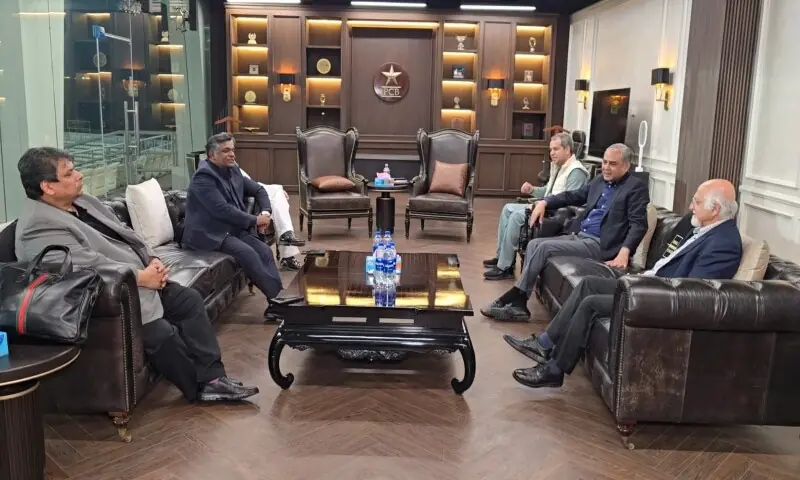
Senior officials from the International Cricket Council (ICC) met representatives of the Pakistan Cricket Board (PCB) and the Bangladesh Cricket Board (BCB) at Lahore’s Gaddafi Stadium on Sunday to deliberate Pakistan’s decision to boycott its T20 World Cup clash with India on February 15.
The meeting continued late into the night, with no official statement issued afterward. Both the ICC and the participating boards declined to brief the media. Sources said discussions lasted around four hours, followed by a dinner break and a planned second round of talks.
According to PCB sources, any final decision is likely to be announced after securing approval from the Government of Pakistan. During the meeting, the PCB reportedly raised concerns over what it described as “large-scale political influence” within ICC affairs, particularly India’s alleged dominance in decision-making through the Board of Control for Cricket in India (BCCI).
Sources added that the ICC had little to offer Bangladesh in terms of compensation beyond ensuring its full share of ICC revenues. ICC Deputy Chair Imran Khawaja is said to have advised the PCB to present its case before the ICC’s arbitration committee or at a board meeting, and to withdraw the boycott, warning that such actions were “not good for cricket.”
Khawaja arrived in Lahore earlier in the evening and was received at the airport by Amir Mir, adviser to the PCB chairman. BCB President Aminul Islam also travelled to Lahore for separate discussions. PCB Chairman Mohsin Naqvi met Islam at Gaddafi Stadium to discuss what the board termed the “ongoing crisis.” The BCB chief thanked Pakistan for its support regarding the T20 World Cup matter. PSL CEO Salman Naseer and other PCB officials were also present.
The high-level engagements come just a day after the ICC Men’s T20 World Cup began. The 20-team tournament has been overshadowed by political tensions after Bangladesh, citing security concerns, refused to play matches in India — a co-host of the event — and were subsequently replaced by Scotland when the ICC rejected their request to relocate fixtures to Sri Lanka.
While Pakistan ultimately agreed to participate in the tournament, it announced it would not play the scheduled match against India in Colombo. In response, the ICC stated that “selective participation” contradicts the spirit of a global event, where all qualified teams are expected to compete as per the official schedule. The governing body urged the PCB to consider the broader consequences for international cricket and to seek a mutually acceptable solution.
A government source previously told Dawn that Pakistan’s decision to skip the India match was intended as a gesture of solidarity with Bangladesh and a protest against what it termed a “biased” ICC decision.
An India-Pakistan encounter is among the most commercially valuable fixtures in world cricket, generating millions in broadcast rights, sponsorships and advertising revenue. Reports suggest the ICC has been engaging in behind-the-scenes efforts to resolve the standoff and avert financial losses.
Sri Lanka Cricket has also urged Pakistan to reconsider, warning that a boycott could hurt not only tournament revenues but also Sri Lanka’s tourism sector, still recovering from the 2022 economic crisis.
If Pakistan forfeits the match, it will lose two points and face a significant setback to its net run rate. Captain Salman Agha has indicated that should the two sides meet later in the semi-finals or final, the team would once again consult the government before taking a decision.