
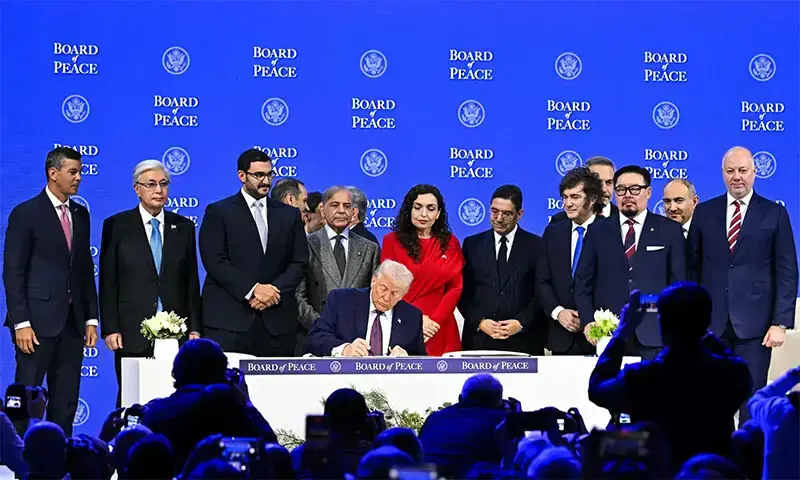
• PM Shehbaz reaches Washington for Trump-led gathering
• Talks to centre on Gaza ceasefire, $5bn US funding pledge and structure of new forum
• Muslim nations cautious about combat role, demand path to Palestinian statehood
WASHINGTON: Prime Minister Shehbaz Sharif arrived in Washington on Wednesday to attend a global summit of the proposed Board of Peace (BoP), convened by US President Donald Trump. The initiative aims to move beyond the Gaza conflict and establish a new mechanism for promoting international peace and stability.
The meeting is expected to focus on three key areas: reinforcing a ceasefire in Gaza, securing financial commitments for the BoP — including an initial $5 billion pledge from Washington — and shaping the institutional framework of a forum President Trump envisions as more agile than the United Nations.
Delegates are also likely to deliberate on the proposed International Stabilisation Force (ISF), which would oversee reconstruction zones and assist with governance arrangements in post-conflict Gaza.
For Pakistan, potential participation in the ISF carries particular weight. The issue reportedly surfaced in talks between Chief of Army Staff Field Marshal Asim Munir and US Secretary of State Marco Rubio during the recent Munich Security Conference.
Diplomatic sources indicate that while several Muslim-majority countries are willing to consider involvement in a stabilisation framework, they are hesitant to assume combat responsibilities that might bring them into direct conflict with Hamas. They are also pressing for a clear and credible pathway towards Palestinian statehood and opposing any annexation moves in the West Bank.
The proposed structure of the BoP — a streamlined, leader-led body supported by an operational arm in the ISF and a dedicated funding pool — reflects Washington’s preference for coalition-based arrangements operating outside the slower, consensus-driven processes of the United Nations. This approach has sparked debate among diplomats and analysts over questions of legitimacy and legality.
Former ambassador Maleeha Lodhi voiced strong reservations about the initiative. She questioned the Board’s legitimacy, noting the absence of Palestinian representation. Without the inclusion of the primary stakeholders, she argued, the forum’s ability to shape a viable post-conflict future for Gaza remains doubtful.
Dr Lodhi also warned that externally imposed governance models risk replicating unequal power structures. She pointed out that several invited countries declined to join, citing concerns over the body’s mandate, effectiveness and its potential to function as a parallel structure to the UN Security Council. She further suggested that Pakistan may have joined prematurely, cautioning that the Board could inadvertently serve as a mechanism to entrench Israeli occupation.
For Prime Minister Shehbaz, the Washington visit extends beyond Gaza. According to Akbar Ahmed, Ibn Khaldun Chair of Islamic Studies at American University, the premier faces both domestic and foreign policy challenges as he navigates the summit.
On the home front, Shehbaz must manage civil-military dynamics amid mounting security pressures, while also dealing with the politically sensitive issue of former prime minister Imran Khan and concerns over his health.
Internationally, the balancing act is even more delicate. While cultivating closer ties with the United States offers economic and military benefits, Pakistan must also preserve its longstanding strategic partnership with China. With tensions simmering along both the Afghan and Indian borders, maintaining equilibrium between Washington and Beijing has become increasingly critical.
For the Trump administration, the summit seeks to secure troop contributions for the ISF, financial backing for reconstruction efforts and political endorsement for a US-led stabilisation model.
For Muslim and Arab nations, however, participation hinges on firm guarantees: a lasting ceasefire, a credible route to Palestinian statehood and a strictly non-combat mandate for any multinational deployment.
How Prime Minister Shehbaz navigates these competing expectations — while coordinating with like-minded states and safeguarding Pakistan’s strategic balance — will shape both the immediate outcome of the summit and Pakistan’s longer-term role in Gaza’s post-conflict landscape.