
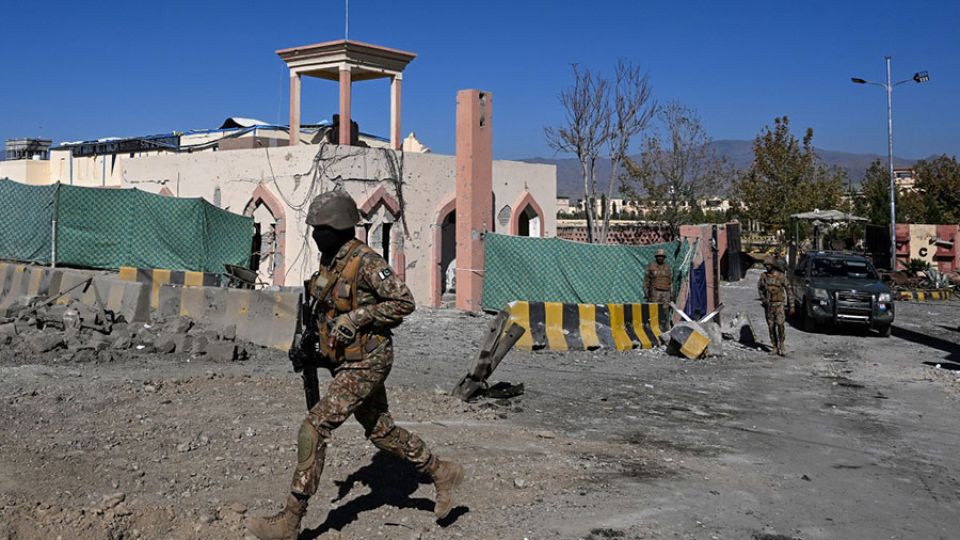
Pakistan’s armed forces carried out overnight airstrikes inside Afghanistan on Friday, destroying militant training camps and support facilities as part of a continuing cross-border operation, security sources said.
According to officials, the strikes were conducted under Operation Ghazab Lil Haq, targeting militant hideouts and infrastructure linked to the Afghan Taliban.
Security sources said the headquarters of the Afghan Taliban’s 313 Corps in Kabul was hit, along with related facilities and an ammunition depot.
In southern Afghanistan, a militant training camp in Kandahar — identified as the Tarawo camp — was also targeted, along with an oil storage facility used to support operations.
Additional strikes were carried out against the Sher-e-Nau militant camp located in Afghanistan’s Paktia province, the sources added.
Afghan authorities confirmed that the attacks took place in Kabul and several border regions, according to international broadcaster TRT World.
The operations come amid Pakistan’s ongoing Operation Ghazab Lil Haq, which began in late February following what Islamabad described as unprovoked firing by the Afghan Taliban from across the border.
Earlier, Information Minister Attaullah Tarar said that hundreds of Afghan Taliban fighters had been killed during the operation. In a statement posted on social media, he said 527 militants had been killed and more than 755 injured. He added that 237 militant check posts had been destroyed, while 38 others were captured and later demolished.
In a subsequent update, the minister raised the death toll to 641 militants and said 243 check posts had been destroyed.
Rising tensions
Relations between Pakistan and Afghanistan have deteriorated since the Taliban returned to power in Kabul in 2021. Islamabad has repeatedly urged the Taliban authorities to dismantle militant sanctuaries on Afghan soil, particularly those associated with the Tehreek-i-Taliban Pakistan (TTP). Pakistani officials say these requests have largely gone unanswered.
Tensions escalated sharply after a Feb 16 suicide attack in Bajaur district near the Afghan border. Militants linked to the TTP attempted to storm the Malangi check post, detonating an explosives-laden vehicle at the perimeter wall after an exchange of gunfire.
The attack killed 11 Pakistani soldiers and a young girl. Seven others — including women and children — were injured when the blast damaged a nearby residential building.
Investigators identified the suicide bomber as Amad, also known as Qari Abdullah or Abu Zar, who was described as a member of the Afghan Taliban’s special forces from Balkh province. The TTP later claimed responsibility for the attack.
Just days later, another suicide bombing during an intelligence-based operation in Bannu district of Khyber Pakhtunkhwa killed a lieutenant colonel and a soldier.
Pakistan’s military has repeatedly stated that militants are using Afghan territory to launch attacks across the border. In a statement, the Inter-Services Public Relations (ISPR) warned that such actions violated the sanctity of the holy month of Ramazan.
“Pakistan will not exercise restraint, and operations will continue against the perpetrators of this heinous and cowardly act,” the military’s media wing said, referring to militant groups it describes as khwarij.
Earlier this year, Defence Minister Khawaja Asif had also warned that Pakistan could carry out strikes inside Afghanistan if cross-border attacks persisted.
Meanwhile, Taliban government spokesman Zabiullah Mujahid had previously accused Pakistan of conducting airstrikes in Afghanistan’s Khost, Kunar and Paktika provinces — claims that Islamabad did not officially confirm or deny.
Cross-border clashes have intensified in recent months. According to the ISPR, fighting along the Pak-Afghan frontier in October last year resulted in the deaths of 23 Pakistani soldiers, while more than 200 Taliban fighters and allied militants were killed.
Pakistan said those clashes began after what it described as an unprovoked attack by Afghan Taliban forces and India-backed militant groups along the border.