
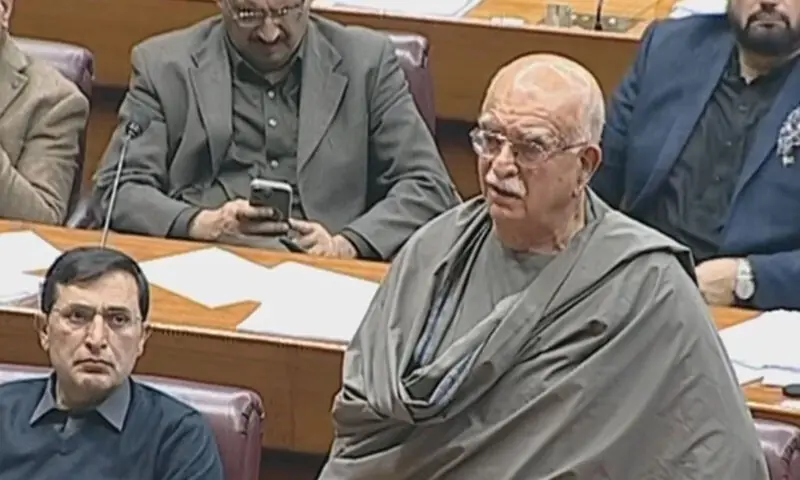
ISLAMABAD: National Assembly Opposition Leader Mahmood Khan Achakzai on Tuesday proposed the formation of a “national government” to help build political consensus among the country’s major parties amid the prevailing regional and domestic challenges.
Speaking on the floor of the National Assembly during a debate on the situation involving Iran, Achakzai stressed the need for unity and collective decision-making.
“We should at least agree on some points,” he said, adding that the era of blaming one another for past mistakes was over.
“We will have to move toward a national government,” he remarked.
Referring to the political setup formed after the February 8, 2024 general elections, Achakzai claimed that the current system led by the PML-N coalition had “collapsed”.
He said the country could only progress through “collective wisdom” and political consensus.
Achakzai further stated that the “establishment” had attempted to weaken former prime minister and PTI founder Imran Khan but had failed to do so.
The opposition leader, who also heads the opposition alliance Tehreek-i-Tahafuz-i-Ayin-i-Pakistan (TTAP), warned of resistance if any attempt was made to politically sideline Imran Khan.
“We will have to agree on some points. We will have to ask the establishment to give some space,” he said.
He also pointed out the absence of Prime Minister Shehbaz Sharif from the session, saying he would have directly addressed him had he been present.
Turning to international affairs, Achakzai criticised United States President Donald Trump, accusing him of pushing the world towards conflict.
He said Pakistan should benefit from the trust the United States places in it, while also emphasising that Afghanistan had been, and would remain, Pakistan’s ally.
Achakzai also proposed that the parliamentary session continue without adjournment so all members could openly present their views.
PPP’s Sharmila Faruqui criticises fuel price hike
Meanwhile, PPP lawmaker Sharmila Faruqui strongly criticised the recent surge in petroleum prices while addressing the National Assembly.
She described Petroleum Minister Ali Pervaiz Malik’s briefing to the house a day earlier as unsatisfactory and “unconvincing”.
Following the escalation in tensions after the February 28 strikes by the US and Israel on Iran, global oil prices have risen sharply, pushing fuel prices in Pakistan to record levels.
Petrol prices have climbed from Rs266.17 to Rs378 per litre, while high-speed diesel has increased from Rs280.86 to Rs520.35 after two major hikes.
Faruqui claimed Pakistan was the first country in the region to raise oil prices in response to the crisis.
She also highlighted inconsistencies in the government’s messaging, noting that Prime Minister Shehbaz Sharif had repeatedly assured the public that the burden of rising prices would not be passed on to them, only for ministers to later announce multiple increases.
She suggested the government hire expert consultants to ensure policy consistency, especially given the uncertainty surrounding the economic fallout of the Middle East conflict.
Faruqui pointed out that petrol currently carries a tax of Rs131 per litre.
“What exactly is the government’s policy? How does it plan to move forward? Diesel prices are also the highest in the region,” she said.
She added that ordinary citizens were increasingly struggling to cope with the cost of living and questioned how people were expected to manage rising expenses.
The PPP leader also criticised the government for focusing only on motorcyclists while ignoring the wider impact on the public.
She urged the government to reduce the profit margins of petroleum companies and adopt a broader strategy to tackle the crisis.
MQM-P seeks briefing on regional implications
Separately, MQM-P lawmaker Javed Hanif called for a comprehensive briefing to the National Assembly on the possible fallout of the ongoing regional conflict.
Speaking during the debate, Hanif demanded that Deputy Prime Minister and Foreign Minister Ishaq Dar, Defence Minister Khawaja Asif, Finance Minister Muhammad Aurangzeb, and senior security officials brief the house on the Middle East situation and its potential implications for Pakistan.
He praised Pakistan’s diplomatic and mediation efforts, saying the country’s international standing had improved.
However, he warned that Pakistan must prepare for all possible outcomes if diplomatic efforts failed.
Hanif expressed concern that the debate had largely centred on fuel prices, which he described as a relatively minor issue compared to the broader regional crisis.
“The entire architecture of the region could change, yet we are only discussing oil prices,” he said.
Referring to US threats against Iran, he warned that any escalation could destabilise Iran’s state structure.
He added that any retaliatory move by Iran could disrupt the Gulf economies, creating serious financial challenges for Pakistan.
“What will happen to the remittances sent by nearly five million Pakistanis?” he asked.
Hanif stressed that the implications for national unity and public sentiment were far more significant than the petroleum price issue currently dominating parliamentary discussions.