
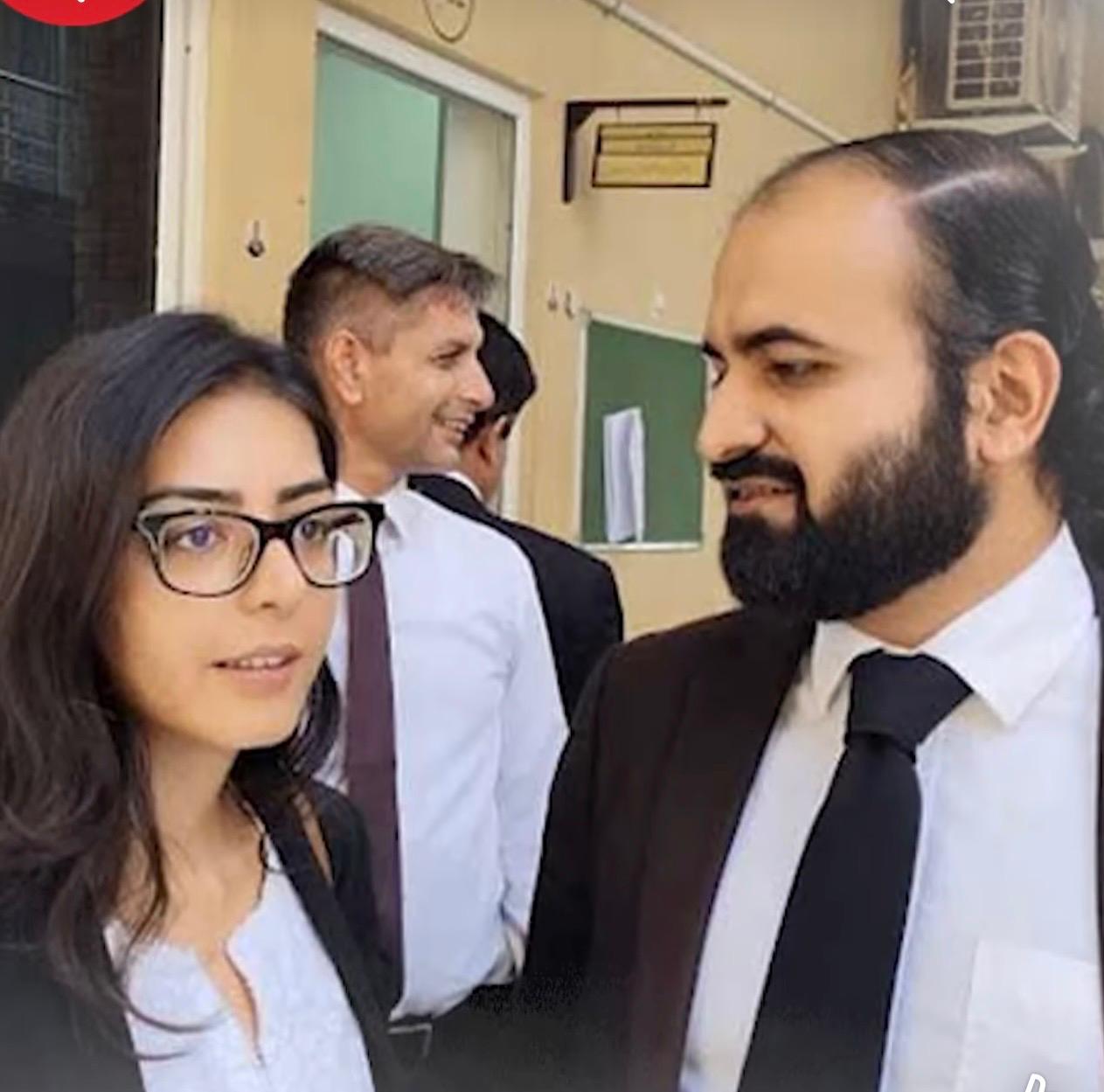
The abuse of power is not merely an administrative failure; it is a betrayal of the state’s most basic obligation to protect rights. The arrest of lawyer Imaan Zainab Mazari-Hazir and her husband, Hadi Ali Chattha, reflects a deliberate strategy of intimidation — one designed to silence those who dare to hold power to account.
As Justice Babar Sattar observed in Shoukat Ali vs Government of Pakistan (PLD 2024 Islamabad 135), dissent is not a threat to the state. On the contrary, it is the engine of social progress. Democracies do not collapse under criticism; they stagnate and decay when it is crushed. A state that presents itself as so fragile that it cannot tolerate critical speech exposes not strength, but insecurity.
Yet, on Friday, that insecurity was on full display. Imaan and Hadi were arrested while reportedly en route to the Islamabad district courts. Multiple cases were registered against them under the Prevention of Electronic Crimes Act (Peca), anti-terrorism laws, and statutes regulating public assembly. Their arrest lays bare the manner in which law is increasingly weaponised to criminalise dissent.
The allegations against Imaan centre on so-called “offensive tweets” directed at “important state institutions”. Hadi’s alleged crime is even more alarming: reposting or resharing her content. In effect, a single click — a digital act of expression — is now enough to invite criminal prosecution.
When criticism is treated as a crime, democracy and the rule of law are hollowed out. When lawyers are punished for challenging state excesses, it is not merely an attack on individuals; it is an assault on the legal system itself.
Peca: a tool of repression
When Peca was amended last year to introduce Section 26-A, criminalising “false and fake information”, the government claimed it was acting to curb misinformation. That justification rings hollow. The amendment has little to do with fake news and everything to do with control.
The cases against Imaan and Hadi invoke provisions relating to cyberterrorism and the dissemination of false information. Yet the true flaw in Peca lies deeper: it is structured to insulate state institutions from criticism. By defining “unlawful content” to include “aspersions against any person”, including members of the judiciary, armed forces, parliament, or provincial assemblies, the law places powerful institutions beyond public scrutiny.
Constitutional democracies do the opposite. They protect the citizen’s right to speak freely, not the sensitivities of those in power.
The pattern of enforcement confirms this reality. According to Freedom Network, citing the Pakistan Federal Union of Journalists, at least 150 journalists faced Peca charges in December 2024 alone, largely for allegedly spreading “false narratives” against state institutions. When a law is disproportionately used against lawyers, journalists, and human rights defenders, its purpose becomes unmistakable.
Case after case, the vague accusation of promoting a “false narrative against the state” is deployed to convert lawful dissent into a punishable offence. No society governed by the rule of law persecutes those who defend it.
A farce masquerading as justice
The Islamabad High Court had granted Imaan and Hadi time to appear before the trial court in the Peca case and explicitly ordered that they not be arrested. Yet almost immediately, another FIR surfaced, levelling patently absurd allegations.
This conduct exposes a dangerous pattern. When courts offer protection, the coercive machinery of the state is simply redirected through fresh FIRs to nullify judicial relief. Court orders are rendered meaningless, and judicial oversight collapses under executive defiance.
One such FIR relates to a protest held in February 2025 — nearly a year ago — when the Judicial Commission of Pakistan met to appoint Supreme Court judges under the 26th Amendment. The FIR alleges slogans were raised against the amendment, the judiciary, and state institutions. Notably, no action was taken at the time. Instead, the case lay dormant, only to be revived conveniently once judicial protection was granted in an unrelated matter.
The FIR also invokes the Peaceful Assembly and Public Order Act 2024 — a law that effectively extinguishes the right to protest in Islamabad. By defining an “assembly” as a gathering of more than 15 people and subjecting it to prior permission, the law hands sweeping powers to the administration. Authorities may revoke permission at will, order dispersal on vague grounds, and impose prison terms of up to three years merely for participating in a protest deemed unlawful.
The message is unambiguous: dissent will not be tolerated — neither online nor on the streets. Legal resistance will be met with retaliation.
Speaking out against enforced disappearances has become grounds for prosecution. Protesting constitutional amendments can trigger criminal cases. Anti-terrorism laws — enacted to combat genuine security threats — are now routinely invoked against lawyers, journalists, and human rights defenders, even as terrorism incidents surge in Balochistan and Khyber Pakhtunkhwa. The state’s priorities could not be clearer.
Power without restraint
The misuse of power is a betrayal of the state’s duty to its citizens. What is unfolding is not accidental excess, but a calculated effort to intimidate those who expose abuse.
The manner of Imaan and Hadi’s arrest was equally disturbing. Amnesty International reported that law enforcement used undue force and failed to provide reasons for the arrest, raising serious concerns about their safety. Former federal minister for human rights Dr Shireen Mazari, Imaan’s mother, stated that she was not even informed where her daughter and son-in-law had been taken.
Arresting individuals without disclosing charges, withholding information from families and counsel, and bypassing due process are not features of lawful governance. They are hallmarks of authoritarian rule.
A compromised judiciary
While two officers of the court are subjected to relentless legal harassment, the post-amendment judiciary appears increasingly unable — or unwilling — to intervene. A judiciary that does not protect rights or restrain executive abuse leaves citizens exposed to arbitrary power.
Under the 26th and 27th amendments, judges of the high courts are subject to “annual performance evaluations” conducted by a Judicial Commission that includes members of the executive. This arrangement places judicial independence under direct threat. A judge who rules against the government risks adverse evaluation by government representatives — a sword of Damocles hanging over every independent decision.
Imaan and Hadi are among the few lawyers who consistently represent Pakistan’s most vulnerable — families of the forcibly disappeared, victims of blasphemy accusations, and others crushed by state overreach. The state’s fear of its human rights defenders is revealing. It is not dissent that threatens power; it is truth.
This case is not only about two individuals facing persecution. It is a warning. Today it is Imaan and Hadi. Tomorrow, it could be any lawyer, journalist, or citizen who dares to speak, question, or resist.