
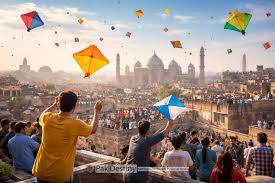
Kite prices soar, charkhi banned, pinnay sell for up to Rs12,000; hotels booked out, rooftops fetching premium rents as Lahore prepares for a tightly regulated revival
After nearly two decades in hibernation, Lahore is preparing to welcome Basant back into its skies — cautiously, tightly regulated, and laden with nostalgia.
For an entire generation, Basant has existed only in family stories and faded photographs. This week, however, the legendary spring festival is set to return for a three-day celebration, offering first-time joy to young Lahoris and a rush of memories for those who remember the golden years when rooftops overflowed with colour, music and cries of “bo kata”.
Yet this revival is unlike any Basant before it. QR-coded kites, strict safety laws, drone surveillance, capped dimensions, and hefty penalties now define the festival. Hotels are running at full capacity, rooftop spaces are being rented at premium rates, and the walled city is alive with anticipation. At the same time, questions linger over enforcement, equity — and what happens once the festival ends.
A generation meeting Basant for the first time
For Lahoris aged between 18 and 25, Basant has long been a secondhand experience.
“Basant was something talked about more than lived — frozen in memories and videos,” says 26-year-old Tuaha Zahid. “This is the first time it feels real.”
Aayat-i-Noor, 25, echoes the sentiment. “This will be my first Basant experienced with my own eyes, not through stories or screens. That makes it incredibly special.”
For older residents, the festival is inseparable from Lahore’s identity. Abu Bakr Masood, who grew up in the 1990s, calls Basant “Lahore’s only genuine product”.
He recalls rooftops filling up by morning, loudspeakers blaring across neighbourhoods, and the city moving in rhythm with the sky. “Every kite cut was a celebration.”
Hassan Ejaz Wyne, 47, remembers flying kites almost daily from childhood into his twenties. “My biggest financier was my naani,” he laughs, recalling how children prepared dozens of kites days ahead of Basant.
But he also remembers how unsafe practices — especially chemical-coated string — eventually overshadowed the joy. “That’s why people got hurt. That’s when it all went wrong.”
In Mozang, 38-year-old Majeed Lashari remembers Basant as a family affair. “On Youm-i-Tana, all the cousins gathered. Food everywhere — samosay, jalebi, karahi, handis, naan from Taj Din. It was a proper festival.”
When Lahore hosted the world
Few names are as closely tied to Basant’s heyday as Yousaf Salahuddin, grandson of Allama Iqbal and owner of Haveli Barood Khana.
During Basant’s peak, his haveli became a magnet for local elites and international visitors alike. “John Reed, chairman of Citibank World, came here during Basant,” Salahuddin recalls. “Naseeruddin Shah, Aamir Khan, Vinod Khanna, Rekha — many celebrities visited.”
Salahuddin believes Basant could have evolved into a multi-million-dollar cultural industry had it been commercially developed in time. “From caterers to flower sellers, musicians to event managers — everyone would have benefited. We lost precious years.”
Kamran Lashari, former DG of the Walled City of Lahore Authority, recalls night Basant as a phenomenon unique to Lahore. “Nearly a million people on rooftops,” he says. “Foreign visitors couldn’t believe it — but even that was an underestimate.”
Fashion designers, hoteliers and traders all benefited. “Spring meant business,” Lashari says.
Strings attached to celebration
The return of Basant has come with sweeping legislation. Under the Punjab Regulation of Kite Flying Act 2025, kite flying is allowed only during officially notified days and under strict conditions.
Violations — including flying banned kites or selling prohibited string — carry penalties ranging from three to seven years’ imprisonment and fines of up to Rs5 million. Even minors face fines, recoverable from parents or guardians.
Only cotton string is permitted — with no more than nine threads — and spools (charkhi) are strictly banned. Kites and string must meet prescribed size limits, be registered with district authorities, and carry QR codes identifying manufacturers and sellers.
Surveillance will involve police, district administration, traffic police, the Punjab Safe City Authority, drones, and the chief minister’s monitoring cell.
While sound system rules may be informally relaxed, officials say no formal notification will be issued.
What happens after Basant remains unclear. Traders must register leftover stock, but authorities have yet to decide how to handle kites already purchased by the public — or whether post-Basant flying will be tolerated. Traditionally, kite flying continued for weeks. This time, the ban will snap back immediately.
The business of Basant
Even before the first kite takes flight, Basant has ignited a thriving economy.
In Lahore’s old city, kite shops are buzzing. Prices have doubled — a kite that cost Rs200 now sells for nearly twice as much, while pinnay that once fetched Rs7,000 are now going for up to Rs12,000.
Rooftops have become prime real estate. In Bhati Gate, Mohsin Fraz says rents range from Rs50,000 to several million rupees, depending on size and location.
“People spend on food, clothes, sound systems. Overseas Pakistanis are coming. There are even middlemen now connecting roof owners with renters,” he says.
Sixty-five-year-old Javed Mughal rents two rooftops, offering complete packages — from food to kites — but only to families. “Earlier, no one rented rooftops. Now it’s a whole industry.”
Hotels are fully booked. Both Pearl Continental and Avari report no availability during the festival, with special Basant packages and concerts planned.
Markets, particularly women’s bazaars, are seeing brisk business in yellow fabric, jewellery and mehndi. Shopkeepers report foreign visitors browsing alongside locals.
Keeping Basant safe
To reduce accidents, the Punjab government has announced free public transport during the festival — 300 buses and 6,000 rickshaws within Lahore, and additional services from nearby cities.
Ride-hailing apps Yango and InDrive will offer up to 180,000 free rides in exchange for advertising rights, officials say.
Motorcyclists are required to install safety antennas, with heavy fines for non-compliance. Police have identified high-risk zones — particularly in the walled city — where entry without safety gear will be prohibited.
Authorities have also published a list of 600 authorised vendors permitted to sell kites and string.
As Lahore flies, Rawalpindi waits
While Lahore celebrates, Rawalpindi remains under a complete ban.
Deputy Commissioner Dr Hassan Waqar Cheema says the prohibition will be enforced “at any cost”, leaving residents frustrated.
“Why Lahore and not Rawalpindi?” asks 30-year-old Muhammad Naeem. “Basant is healthy, cultural, and joyful. Just ban dangerous strings.”
Others argue kite flying is one of the few accessible activities in dense neighbourhoods. Despite the ban, illegal flying continues — a reminder that Basant’s pull is hard to suppress.
As Lahore prepares to reclaim its skies, the revival of Basant has reignited joy, commerce and debate — along with an enduring question: can the festival truly return without losing its soul?