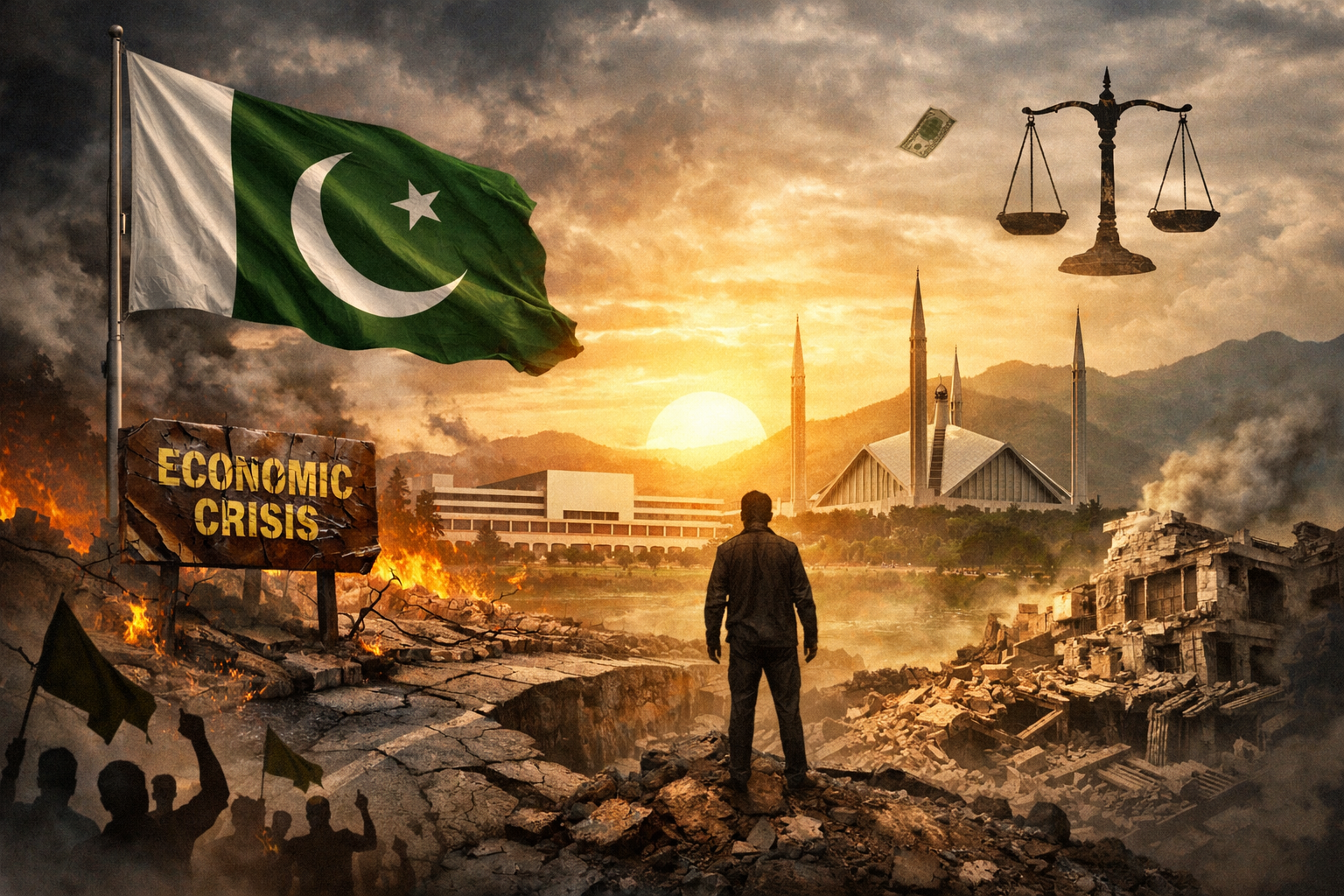
It was a dark moment in 2022 when I watched the Prime Minister of Pakistan address the nation and openly declare that the country was heading toward default. The words struck like a detonative wave, sending shockwaves across the nation. Never before had a sitting prime minister used such a term so candidly. The announcement left people anxious, fearful, and deeply unsettled, as if ominous clouds of uncertainty were gathering over Pakistan.
As a young citizen, it felt as though I was witnessing the gradual disintegration of my homeland. The sky appeared bleak, hope seemed fragile, and everything felt on the brink of collapse. The year 2022 marked a decisive turn in the country’s trajectory, with 9th May emerging as a pivotal and deeply troubling chapter in Pakistan’s history. In Lahore, troops witnessed stones shattering the windows of their vehicles. This was not merely the breaking of glass; it symbolized the fracture of collective emotions and national dignity. It was, undeniably, a dark day, one that should never have unfolded in such a manner. Indeed, “Al-Fitnah is worse than killing.”
Following the regime change, the nation experienced months of unrelenting chaos. The political environment resembled a crowded marketplace, where everyone was shouting, yet no one was listening. When the current government assumed power, expectations were already minimal. History has often shown that joint political alliances tend to struggle with governance, and public confidence was already eroded. At that time, vision felt obscured and optimism nearly nonexistent.
However, with the passage of time, gradual signs of stabilization began to surface. Initially, the public resisted acknowledging any improvement, remaining trapped in a phase of denial. Yet reality slowly compelled us to confront the truth: the country was wounded, but it was not destroyed. Pakistan was still standing.
In Punjab particularly, certain developments forced people to pause and reassess their assumptions. Despite sustained criticism, the provincial government initiated and revived several programs aimed at public welfare and institutional recovery. These included the expansion of free medicine schemes in government hospitals, mobile clinics reaching remote and underdeveloped regions, solar panel initiatives to reduce the electricity burden on low-income households, educational support programs for students, infrastructure rehabilitation across major and secondary cities, agricultural relief packages for farmers, price control measures during inflationary pressure, and cleanliness and social welfare programs such as Suthra Punjab and the Dhi Rani initiative.
Furthermore, the introduction of the Crime Control Department, crackdowns on land mafias, the establishment of regulatory forces, green bus services, safe city projects, and stricter oversight in education collectively challenged the dominant narrative that nothing was being done.
These measures did not resolve every issue, nor did they eliminate public suffering. However, they disrupted the perception of complete stagnation. Predictably, many readers may stereotype this acknowledgment as blind support. Those entrenched in despondency often refuse to listen, observe, or accept any development associated with the current government, a mindset that is neither rational nor constructive. A state is far greater than any single individual. Yet every initiative is instantly discredited to satisfy emotional frustration and political denial. When people are conditioned to believe that only one figure embodies integrity while all others are inherently corrupt, denial becomes a common psychological refuge.
The year 2025 feels like a phase of revival, a convergence of resilience, diplomatic engagement, and strategic recovery. Those who still argue that Pakistan has failed to perform must revisit their understanding of the situation. Unfortunately, political allegiance continues to cloud judgment. Even during moments of national crisis, such as the outbreak of conflict, voices emerged dismissing reality as fabrication for political victimization. Such responses raise serious questions about political maturity and national responsibility.
Meanwhile, one province continues to suffer in alarming neglect. Its people remain deprived of basic necessities such as healthcare, infrastructure, and essential services, let alone large-scale development projects.
The seriousness of governance can be judged when an elected chief minister publicly prioritizes personal political devotion over public duty (Ishq-e-Imraniya). This raises a critical question: is governance a spectacle, and are millions of lives merely an afterthought?
Many will still choose to keep their eyes closed, unwilling to confront reality. Yet if we objectively compare the period when default appeared inevitable to the present, it is evident that Pakistan has healed far more than anticipated. The time has come to set emotions aside and focus on nation-building.
There exists a deep dualism within our society. People desire prosperity like China without embracing its discipline, admire Russia’s assertiveness without accepting its system, and aspire to Saudi-style wealth without acknowledging its structure. Diplomacy remains essential, but certain institutions within a state are indispensable. Believing that even the world’s most powerful nation operates without institutional influence is a misunderstanding of global governance.
Perfection does not exist. Every system has flaws, loopholes, and shortcomings. Criticism is necessary, but it must be constructive rather than destructive. Instead of remaining trapped in emotional outrage, individuals must seek opportunity, work hard, innovate, and contribute. Pakistan is abundant with potential. It can become a paradise if we collectively choose to build it.
For just five minutes, step onto neutral ground, free from emotion, bias, and political obsession, and reflect.
Pakistan Zindabad!