
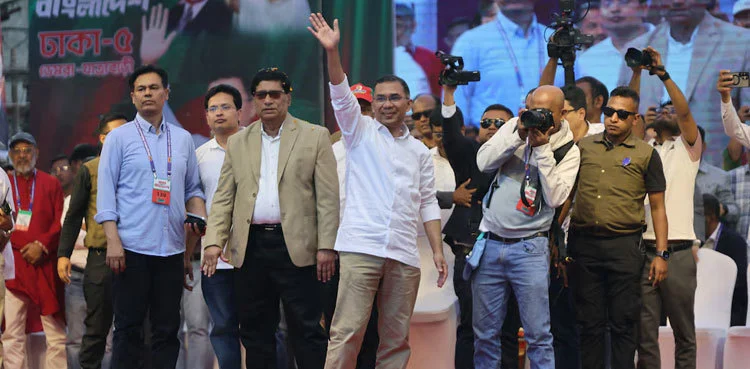
Bangladesh’s prime minister-designate Tarique Rahman and newly elected lawmakers were sworn in on Tuesday, marking the first parliament formed since the deadly 2024 uprising that reshaped the country’s political landscape.
Rahman is set to replace the interim administration that has governed the nation of 170 million people for the past 18 months following the ouster of former premier Sheikh Hasina. The oath-taking ceremony was conducted by Chief Election Commissioner AMM Nasir Uddin, with lawmakers pledging allegiance to the country.
Members of the Bangladesh Nationalist Party (BNP) are expected to formally elect Rahman as their parliamentary leader. President Mohammed Shahabuddin is then scheduled to administer the oath of office to the new prime minister and his cabinet later in the day.
Rahman, 60, head of the BNP and heir to one of Bangladesh’s most influential political families, secured a sweeping victory in the February 12 elections. In his post-election address, he described the outcome as a triumph for democracy and for citizens who had struggled and sacrificed to uphold it.
At the same time, he acknowledged the significant hurdles ahead, pointing to a fragile economy inherited from the previous regime, weakened institutions, and deteriorating law and order. Rahman has vowed to stabilise the country and restore economic momentum, particularly in the garment sector, where Bangladesh ranks as the world’s second-largest exporter.
He has also urged political unity in a nation long divided by intense rivalries.
A political comeback
Rahman’s ascent marks a dramatic return to national politics. He came back to Bangladesh in December after spending 17 years in exile in the United Kingdom.
The BNP-led coalition captured 212 seats in parliament, while the Jamaat-e-Islami-led alliance won 77 seats. Jamaat, which significantly increased its parliamentary presence compared to previous elections, has contested the results in 32 constituencies. However, its leader, Shafiqur Rahman, has pledged that the party will act as a “vigilant, principled, and peaceful opposition.”
The Awami League, led by Hasina, was barred from participating in the polls. Hasina, who has been sentenced to death in absentia on charges of crimes against humanity, issued a statement from India denouncing the election as illegitimate.
India nevertheless welcomed the BNP’s decisive victory, signalling a possible thaw in previously strained bilateral relations.
Women secured seven directly elected seats, while an additional 50 reserved seats for women will be distributed among parties based on their share of the vote. Four representatives from minority communities were elected, including two Hindus, who make up around seven per cent of the population in Muslim-majority Bangladesh.
Despite pre-election tensions, polling day was largely peaceful, and the country has reacted calmly to the results. Analysts suggest that the new government’s ability to address economic challenges will be key to ensuring broader stability in the months ahead.