
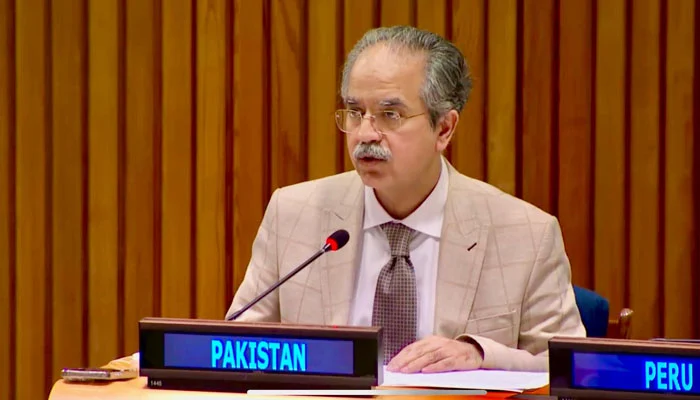
Pakistan has warned the United Nations Security Council that the collapse of diplomatic efforts in the Middle East has made the Iranian nuclear issue more difficult to resolve, as UN chief António Guterres cautioned that the growing crisis poses a serious risk to global peace and security.
Addressing a Security Council briefing on the committee overseeing sanctions linked to Iran’s nuclear programme, Pakistan’s envoy to the UN, Asim Iftikhar Ahmad, pointed to sharp divisions among Council members regarding the sanctions monitoring body.
“The Council remains divided on the 1737 Committee issue,” Ambassador Ahmad said, noting that the disagreement has delayed the appointment of chairs for several subsidiary bodies and hampered their functioning.
He stressed that such disputes should not disrupt the Council’s routine work. According to him, the lack of agreement on the committee’s report had prompted the current meeting and highlighted the urgency of resolving the issue.
The sanctions committee, created under United Nations Security Council Resolution 1737, monitors restrictions placed on Iran’s nuclear programme. Its responsibilities include reviewing reports from the International Atomic Energy Agency, assessing compliance with the sanctions regime, considering exemption requests, and identifying individuals or entities subject to penalties.
The discussion took place against the backdrop of escalating tensions in the Middle East. In separate messages, Guterres warned that the crisis represents a “grave threat to international peace and security” and has already caused widespread suffering among civilians.
He cautioned that continued military escalation could trigger a broader and uncontrollable conflict, urging all parties to pursue de-escalation, dialogue and renewed negotiations.
UN agencies have also expressed concern about the humanitarian consequences of the crisis, reporting that more than 1,100 children have been killed or injured while millions face disrupted schooling and displacement.
Ambassador Ahmad said recent developments, including what he described as “unprovoked and unwarranted attacks on Iran,” had significantly affected the broader context of the nuclear issue.
“Regrettably, the breakdown of diplomacy on the Iranian nuclear issue has further complicated an already complex matter that has been on a downward slide over the past few months,” he said.
Despite the tensions, he maintained that the core principles of the Joint Comprehensive Plan of Action and the consensus adoption of United Nations Security Council Resolution 2231 remain valid.
Describing the JCPOA as a product of dialogue and pragmatic diplomacy, he said it provided a roadmap for addressing the concerns of all parties through reciprocal commitments and peaceful dispute resolution.
Reaffirming Pakistan’s stance against the use of force, Ahmad said Islamabad had condemned attacks on civilian infrastructure and strikes on nuclear facilities under IAEA safeguards.
“Strikes against nuclear facilities carry serious environmental and safety risks for local populations and for the wider region,” he warned.
He also emphasised that the IAEA’s verification work must continue without disruption, noting that the agency plays a crucial role in objectively monitoring compliance with nuclear safeguards in Iran.
Referring to United Nations Security Council Resolution 2788 adopted last year, Ahmad urged the Council to revive the principles of the UN Charter and prioritise peaceful solutions to prevent further escalation in the region.