
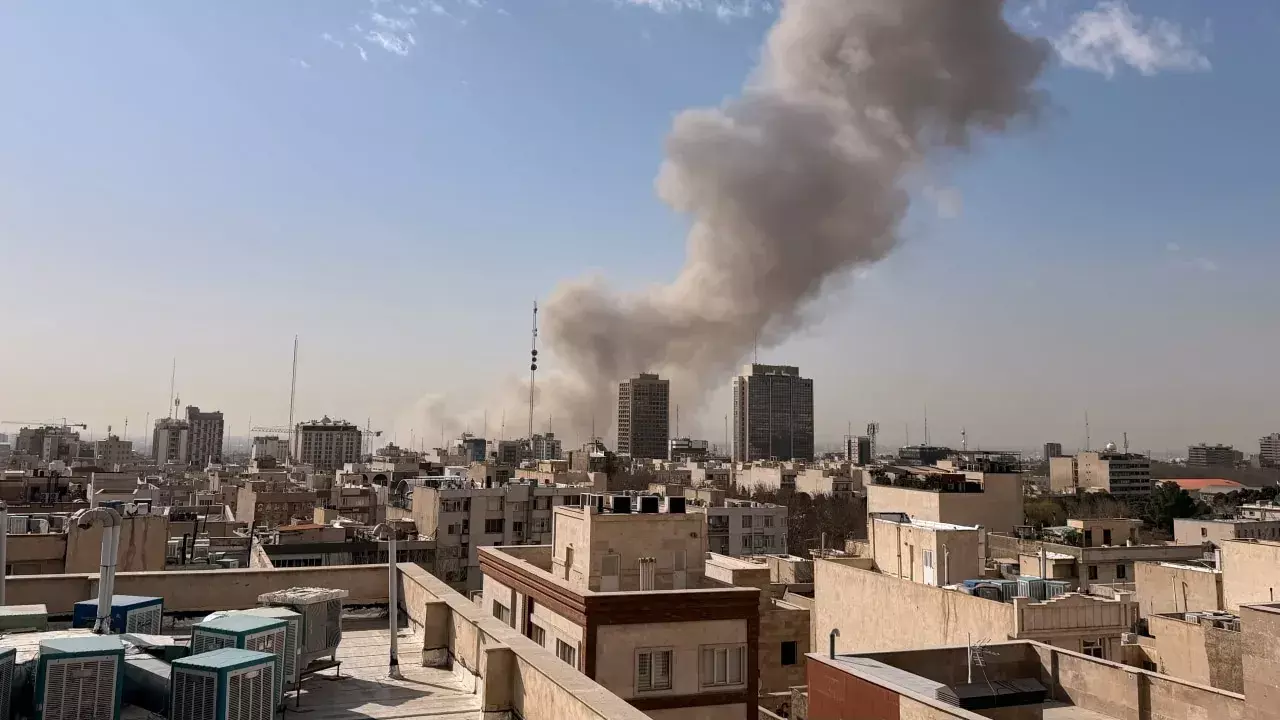
• Tehran confirms supreme leader’s death, announces 40 days of mourning
• Israeli strikes hit Tehran for second day; nine killed in retaliatory attack in Israel
• US reports sinking Iranian vessels, B-2 bombers target missile sites; three American troops dead
• Strait of Hormuz shut, global shipping disrupted
• Trump says campaign may last four weeks; Iran signals openness to talks but vows unrestricted self-defence
JERUSALEM: The confrontation between Iran and the US-Israel alliance intensified dramatically after Tehran confirmed that Supreme Leader Ayatollah Ali Khamenei was killed in a joint airstrike, pushing the Middle East into one of its most volatile moments in decades.
Iran declared 40 days of national mourning and announced public holidays following the death of the leader who had held ultimate authority since 1989. As tensions soared, Iranian missile strikes killed at least nine people in the Israeli city of Beit Shemesh, while Israeli and US forces continued pounding targets in Tehran and other areas.
The exchange of attacks has shaken global markets and disrupted crucial Gulf shipping lanes, raising fears of a broader regional war.
Top commanders among those killed
Israel said coordinated strikes eliminated around 40 senior Iranian officials. Iranian state media confirmed several high-profile casualties, including Revolutionary Guards commander Gen. Mohammad Pakpour, armed forces chief Abdolrahim Mousavi, Defence Minister Aziz Nasirzadeh, senior aide Mohammad Shirazi, police intelligence chief Gholamreza Rezaian and adviser Ali Shamkhani.
Iranian outlets also reported that members of Khamenei’s immediate family were killed. State media said he was in his office when the strike occurred.
US President Donald Trump said American intelligence had closely monitored Khamenei’s movements, asserting that the operation left no opportunity for escape.
Escalation widens
Israeli military spokesperson Lt. Col. Nadav Shoshani said air raids were aimed at clearing a “path to Tehran,” claiming much of Iran’s air defence network in western and central regions had been dismantled. Prime Minister Benjamin Netanyahu vowed further action, saying Israel had not yet used its full force.
Iran responded with missile barrages targeting Israel and countries hosting US bases. Emergency service Magen David Adom confirmed multiple casualties in Beit Shemesh.
Iran’s Revolutionary Guards claimed to have targeted the aircraft carrier USS Abraham Lincoln, though the Pentagon rejected the claim. The Guards also reported missile strikes on oil tankers in the Gulf and the Strait of Hormuz, assertions that could not be independently verified.
Acting President Masoud Pezeshkian labelled Khamenei’s killing a “declaration of war,” while senior official Ali Larijani promised a response of unprecedented scale.
Meanwhile, United States Central Command said US forces struck an Iranian corvette in the Gulf of Oman at the outset of operations. B-2 stealth bombers were also deployed against fortified ballistic missile facilities.
Trump indicated the military campaign could last about four weeks, acknowledging casualties after the Pentagon confirmed three US service members had been killed.
Shipping chaos and diplomatic signals
The fighting has disrupted the Strait of Hormuz, a vital route for global energy supplies. The Islamic Revolutionary Guard Corps declared the waterway closed, prompting dozens of tankers to halt in open waters. Major shipping companies suspended operations in the region.
Despite the escalation, diplomatic contacts persisted. Oman said Iranian Foreign Minister Abbas Araghchi conveyed openness to serious de-escalation efforts to his Omani counterpart Badr Albusaidi, while maintaining that Iran’s right to self-defence had no limits.
The United Nations’ nuclear watchdog scheduled an emergency meeting at Russia’s request. European Union foreign policy chief Kaja Kallas described the killing as a pivotal moment in Iran’s history, saying its future path remained uncertain.
Conflict persists
Strikes continued across Iran, including in the western city of Mehran, where dozens of security personnel were reported killed. Iranian media said Tehran’s Gandhi Hospital was damaged in air raids, releasing footage showing debris scattered inside.
Israel announced plans to mobilise nearly 100,000 reservists under “Operation Roaring Lion,” signalling preparations for a sustained campaign.
Analysts warned that although the loss of senior leaders represents a severe blow to Tehran, it may not dismantle the country’s entrenched clerical establishment or the Revolutionary Guards’ influence — suggesting the conflict could intensify before any resolution emerges.