
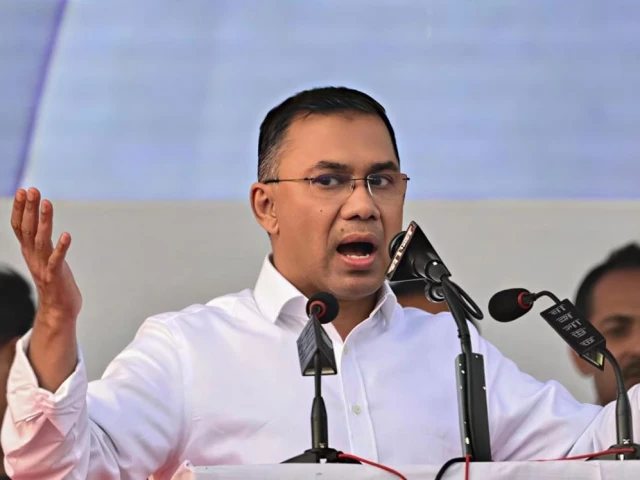
After nearly two decades in self-imposed exile in London, Tarique Rahman is poised for a stunning political comeback. If polls hold, the soft-spoken 60-year-old could soon lead Bangladesh as prime minister—following in the footsteps of his parents.
Rahman left Bangladesh in 2008 for medical treatment after being detained under a military-backed caretaker government during a corruption crackdown. His return last Christmas was met with a hero’s welcome, following a youth-driven uprising that ousted his family’s longtime political rival, Prime Minister Sheikh Hasina, in August 2024. Hasina now lives in exile in New Delhi.
Rahman hails from a political dynasty: his mother, Khaleda Zia, served as prime minister, while his father, Ziaur Rahman, was a key figure in Bangladesh’s independence and ruled from 1977 until his assassination in 1981.
Since returning, Rahman has focused on reshaping Bangladesh’s global ties to attract investment while avoiding overreliance on any single power—contrasting with Hasina’s pro-India tilt. Domestically, he has promised expanded financial support for poor families, diversification away from garment exports into industries like toys and leather goods, and the introduction of a two-term, 10-year limit for prime ministers to curb autocratic rule.
Events have moved so rapidly that Rahman says he has scarcely had time to reflect on the whirlwind. “I don’t know how we have passed every minute since we landed,” he told Reuters, joined by his daughter Zaima, who has been actively campaigning for him.
Born on November 20, 1965, in Dhaka, Rahman studied international relations at the University of Dhaka before venturing into textile and agricultural businesses. Since his return, he has sought to shed the image of a brash power-broker from the BNP’s 2001–2006 era, projecting instead a statesmanlike persona focused on peace, stability, and reconciliation.
“What does revenge bring to someone? People have to flee from this country because of revenge. This does not bring anything good,” he said.
During Hasina’s tenure, Rahman faced multiple corruption convictions and a life sentence for a 2004 grenade attack on a rally she addressed—charges he always denied as politically motivated. Since her ouster, he has been acquitted in all cases.
Now, Rahman has embraced a quieter style, calling for rebuilding institutions and restoring citizens’ stake in the state—a message energizing BNP supporters. Even the family’s Siberian cat, Jebu, has gone viral, helping soften his public image.
Within the BNP, Rahman wields firm control, personally overseeing candidate selection, alliances, and strategy. Despite his dynastic background, he insists democracy will be his guiding priority.
“Only by practising democracy can we prosper and rebuild our country. If we practise democracy, we can establish accountability. We want to rebuild our country,” Rahman said.
From exile to the brink of power, Tarique Rahman’s return could redefine Bangladesh’s political landscape—balancing legacy, reform, and the promise of a new chapter.