
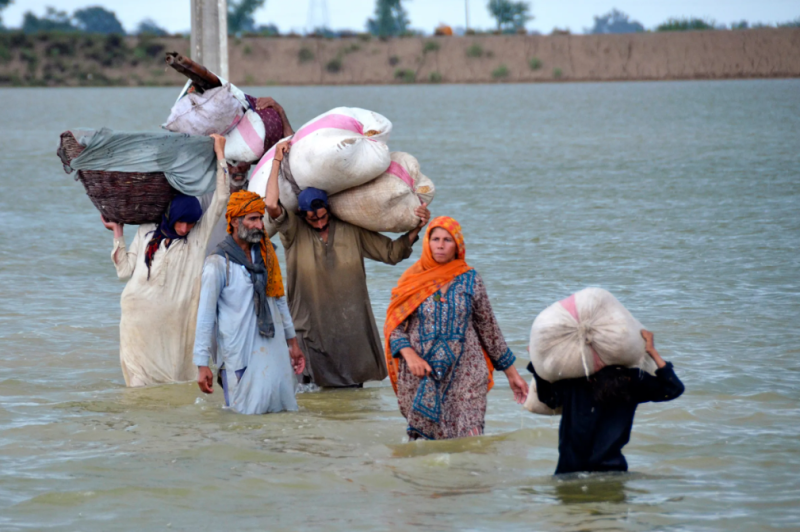
The floods of 2022 and 2025 were not simply natural calamities. They exposed the fault lines in Pakistan’s social and governance systems — revealing who is shielded from disaster and who is repeatedly left in harm’s way.
When heavy monsoon rains swept across the country again in 2025, they reignited a familiar dread. It was not because the rainfall was unprecedented, but because millions had come to realise that floods are no longer rare, once-in-a-generation events. They are recurring crises.
According to the National Disaster Management Authority (NDMA), the 2025 floods claimed at least 1,000 lives and affected nearly seven million people nationwide. Punjab bore the brunt, followed by Khyber Pakhtunkhwa and parts of Gilgit-Baltistan. Crops spanning hundreds of acres were destroyed, homes collapsed, and entire communities were uprooted.
Each flood leaves behind the same troubling questions: Why are certain families devastated time and again? Why do the same villages and neighbourhoods suffer repeatedly? Why do some households rebuild swiftly while others struggle for years?
Researchers argue that floods do not create vulnerability — they expose it. This concept, known as social vulnerability, goes beyond income levels. It encompasses where people live, the security of their livelihoods, access to services, political representation, and whether institutions respond to their needs. When exposure to hazards combines with poverty, weak infrastructure, and limited coping capacity, disaster becomes inevitable.
Studies in Pakistan and globally show that social and economic conditions long before a storm hits determine who suffers most. In flood-prone regions, households with low education levels, insecure housing, minimal land ownership, and poor access to healthcare and social protection endure greater losses and slower recovery. More than a third of families in such areas fall into high social vulnerability categories, meaning even moderate flooding can trigger prolonged hardship.
Informal settlements, often excluded from official planning despite housing essential urban labour, are especially at risk. These communities frequently receive the least protection and the slowest assistance.
The 2022 floods were a watershed moment. Affecting more than 30 million people and causing over $30 billion in economic losses, they laid bare deep structural weaknesses. In Sindh, districts with fragile infrastructure and limited political clout remained submerged for months. Women, tenant farmers, and landless labourers faced prolonged food insecurity, mounting debt, and forced migration.
By the time floods struck again in 2025, many families were still recovering from the previous disaster. In Punjab, river overflows and drainage failures hit small farmers and daily-wage workers hardest. Many had already sold livestock or assets to survive earlier losses; this time, they had little left to fall back on.
In Khyber Pakhtunkhwa, flash floods and landslides devastated mountainous districts where limited infrastructure and weak institutional reach amplified the damage. In Gilgit-Baltistan, glacial melt and sudden flooding severed roads and isolated valleys, underscoring the growing risks climate change poses to high-altitude communities.
The pattern is clear: when underlying vulnerability is ignored and recovery remains incomplete, disasters repeat their toll — regardless of whether rainfall intensifies.
Pakistan does not lack disaster management authorities or policy frameworks. What remains absent is a governance approach centred on reducing vulnerability. Planning continues to prioritise physical infrastructure, yet embankments and roads alone cannot protect people who remain economically insecure and politically marginalised.
Persistent data gaps, poor institutional coordination, limited local government capacity, and minimal community participation weaken resilience efforts. Disasters are treated as temporary emergencies rather than symptoms of deeper structural inequities.
Decades of research point to a straightforward lesson: resilience begins with accountable and inclusive governance. Strengthening local institutions, enforcing fair land-use planning, expanding social protection, and involving communities — particularly women and marginalised groups — in early warning systems and recovery efforts are essential steps.
Most importantly, vulnerability must be recognised as a development challenge, not merely a disaster management issue. When inequality narrows and institutions function effectively, disasters lose much of their destructive force.
The floods of 2022 and 2025 were not acts of nature alone. They reflected how society is organised — and who it fails to protect.
If Pakistan continues to rebuild roads and embankments without rebuilding institutions, floods will keep returning to the same doorsteps. But if vulnerability reduction becomes central to governance, recovery can be faster, resilience stronger, and disasters survivable.
The rains will come again. The question is whether they will once more find the same people waiting.