
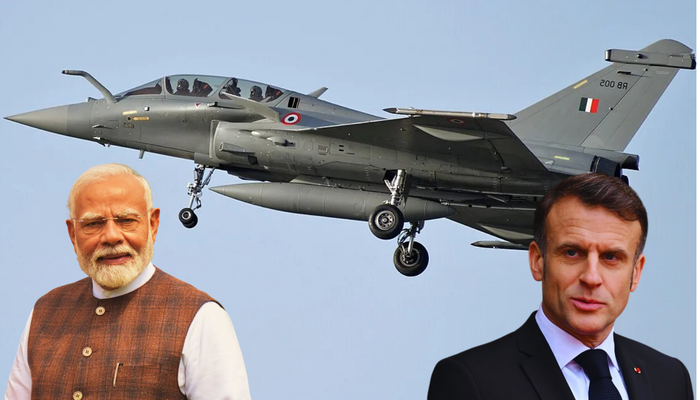
French President Emmanuel Macron began a three-day visit to India on Tuesday, with key discussions set to focus on artificial intelligence collaboration and a potential multibillion-dollar deal for additional Dassault Rafale fighter jets.
France aims to deepen its defence partnership with New Delhi, including negotiations over a contract for potentially 114 more Rafale jets. Macron and his wife Brigitte Macron arrived in Mumbai, India’s financial hub, late Monday, marking his fourth visit to the country since taking office in 2017.
Macron is scheduled to meet Prime Minister Narendra Modi on Tuesday, followed by an artificial intelligence summit in New Delhi on Wednesday and Thursday. The visit comes after India confirmed last week its plans to place a major Rafale order and following the signing of a landmark EU-India free trade agreement in January.
“Contract of the century”
India has sought to diversify its defence suppliers over the past decade, reducing dependence on Russia while promoting domestic production. A defence ministry statement last week confirmed the proposed Rafale purchase, noting that most jets would be manufactured in India. While the ministry did not specify numbers, sources indicated 114 aircraft were likely.
Christophe Jaffrelot, an India expert at Sciences Po in Paris, described the potential $35 billion deal as the “contract of the century” and a potential milestone in bilateral relations. If finalized, the jets would supplement 36 Rafales acquired in 2016 and 26 ordered for the Indian Navy. Negotiations with Dassault Aviation continue, with French officials optimistic about reaching a “historic” agreement.
Strengthening strategic ties
On Tuesday, Modi and Macron will also inaugurate India’s first helicopter final assembly line via videoconference from Mumbai. The Vemagal facility in Karnataka, a joint venture between Tata Group and Airbus, will produce the best-selling single-engine Airbus H125 helicopter.
France has become one of India’s most significant defence and economic partners in recent years. Macron’s office stated that the visit aims to further “strengthen cooperation” and diversify France’s economic and trade partnerships. India, with a population of 1.4 billion, is on track to become the world’s fourth-largest economy.
The talks are also expected to cover global economic uncertainties arising from US tariff policies and China’s growing influence in the region. Modi’s office said discussions will focus on “cementing the strategic partnership and expanding it into new and emerging areas.”
Bilateral trade, largely driven by defence and aerospace, stands at around $18 billion annually, while French direct investment in India totals nearly $15 billion. Analysts note strong personal rapport between the two leaders as an asset to deepening ties.
A sensitive issue remains Ukraine, where India has maintained trade with Russia despite its 2022 invasion. US President Donald Trump has reportedly pressed India to halt Russian oil purchases, though New Delhi has not formally confirmed compliance. Jaffrelot noted that if India stops buying Russian oil, it could avoid international criticism while maintaining its strategic autonomy.