
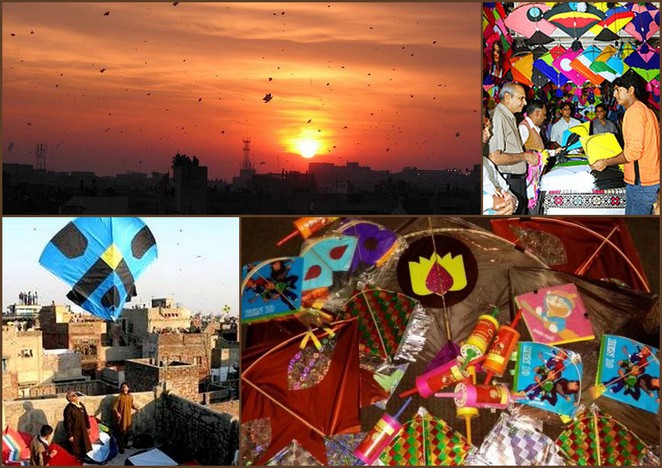
Basant — also known as Jashn-i-Baharaan — has for centuries signalled the arrival of spring in Punjab, marking the end of winter’s restraint and the return of warmth, colour and motion. Rooted in the ancient idea of Vasant, spring as both natural renewal and emotional rebirth, the festival gradually evolved from a seasonal marker into a richly layered cultural expression. Traditionally observed around the fifth day of Magh, Basant was never limited to a single ritual. It emerged instead as a collective mood: yellow garments mirroring mustard fields, rooftops alive with kites, kitchens fragrant with seasonal dishes, and streets charged with anticipation. In this sense, Basant belonged less to the calendar than to the inner life of the region.
In pre-modern Punjab, spring was not simply observed — it was welcomed. The colour yellow symbolised agricultural abundance and the strengthening sun, while kite flying transformed the sky into a shared space of play and competition. The festival gained particular prominence in the 19th century during the reign of Maharaja Ranjit Singh, who formalised Basant celebrations at the Sikh court. Dressed in yellow and flying kites from palace rooftops, the ruler elevated a folk tradition into a courtly spectacle without severing its popular roots. Cities such as Lahore, Amritsar and Kasur became synonymous with Basant, their skies crowded with competing kites and their rooftops ringing with laughter, music and cries of triumph. Even with royal patronage, the festival remained firmly embedded in everyday life.
It was in Lahore, however, that Basant acquired its most distinctive urban character. Over time, it became woven into the city’s annual rhythm — a moment when social boundaries softened and neighbourhoods opened themselves to one another. Rooftops ceased to be private enclosures and became shared platforms of celebration. Kite makers, string dyers, musicians, food vendors and artisans all found their livelihoods tied to the season. For a few days, the city seemed to breathe differently.
Cultural historian Nazir Ahmad Chaudhary captures this spirit vividly in Basant: A Cultural Festival of Lahore. In one passage, he writes, in translation:
“Basant was not merely the act of flying kites; it was the moment when Lahore lifted its head towards the sky. For a few days, the city forgot its divisions — rooftops became shared spaces, strangers exchanged greetings, and even silence felt festive.”
Elsewhere, reflecting on the festival’s inclusive nature, he observes:
“No one asked who believed in what. The kite did not inquire whether the hand that released it was Muslim, Hindu, or Sikh. Basant belonged to the season — and the season belonged to everyone.”
For Chaudhary, Basant represented a form of urban civility — a lived culture rather than a religious rite, an expression of how a city learned to live with itself.
A similar sensibility appears in the work of A. Hameed, though in a more intimate and elegiac register. In essays such as Lahore Ki Yaadein, Basant emerges as a reservoir of memory and feeling. He recalls the city during the festival as if it were briefly released from the weight of time:
“In Basant, Lahore behaved like a child promised a fair. Even the old forgot their age, and the poor forgot their troubles — if only for a day. The sky became a page on which the city wrote its happiness in colour.”
Reflecting on the festival’s disappearance, he writes:
“When Basant vanished, something else vanished with it — the courage to be openly joyful. A city that stops celebrating the seasons slowly stops recognising itself.”
His words suggest that festivals like Basant function as emotional infrastructure, sustaining a city’s humanity just as roads and buildings sustain its movement.
Beyond social practice and memory, Basant has long occupied a rich place in South Asia’s poetic and mystical imagination. Spring’s association with renewal, love and awakening made it a natural metaphor for poets and Sufis alike. Amir Khusrau, the 13th-century poet and musician, is perhaps the most iconic figure linked to Basant’s poetic spirit. Legend holds that upon witnessing Basant celebrations — women dressed in yellow, fields blooming with mustard — Khusrau donned yellow himself and composed verses in praise of the season. In a widely attributed sense-translation, he exclaims:
“Sakhi, Basant has arrived —
the earth wears yellow,
the sky leans closer,
and even sorrow loosens its grip.”
In Khusrau’s work, spring is both literal and metaphysical: the blossoming of the earth mirrors the awakening of the soul, and joy becomes a path to the divine.
Punjabi Sufi poetry carried this symbolism forward. Shah Hussain’s kaafis draw a direct parallel between the fields and the heart:
“When Basant blooms in the fields,
let it bloom in the heart as well.”
External change, the poets remind us, remains incomplete without inner renewal. Even Bulleh Shah, who did not write explicitly about Basant, resonates with its spirit through his imagery of colour, movement and freedom. In the modern era, Faiz Ahmed Faiz reimagined spring as a metaphor for hope and resistance, urging that colour be returned to the gardens even when the season resists — an echo of Basant’s enduring promise of renewal under constraint.
Historically, Basant flourished within a pluralistic social landscape. Pre-Partition Punjab saw Muslims, Hindus and Sikhs participating in the festival together, often without conscious attention to religious difference. While Basant Panchami held religious meaning for some, the Punjabi expression of Basant was broadly secular, grounded in nature rather than doctrine. It embodied the syncretic Ganga-Jamuni ethos shaped by shared language, music, food and seasonal rituals. Its suppression in the early 2000s through a blanket ban on kite flying disrupted not only a practice, but a collective memory, leaving many Lahoris feeling that a vital thread connecting past and present had been severed.
The recent, regulated revival of Basant has therefore been met with cautious optimism. For many, it represents not merely the return of kites to the sky, but the re-entry of colour, rhythm and communal joy into public life. Contemporary writers have described Basant as “the last festival that did not ask for identity cards”, “a rehearsal for coexistence”, and “a sky large enough for everyone’s dreams” — phrases that underline its symbolic weight in an age marked by fragmentation and anxiety.
Ultimately, Basant endures because it speaks to something elemental: the human need to celebrate change, to mark time not only through hardship but through joy. From Amir Khusrau’s verses to Nazir Ahmad Chaudhary’s histories, from A. Hameed’s nostalgia to the lived memories of generations of Lahoris, Basant emerges as a living archive of shared heritage. It reminds us that culture survives not through preservation alone, but through participation — and that to celebrate the seasons together is also to reaffirm faith in one another.