
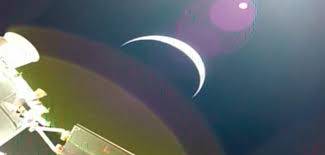
The Artemis astronauts entered the final phase of their mission on Monday as the Orion spacecraft moved into the Moon’s gravitational pull, marking a major milestone ahead of the first crewed lunar flyby since 1972.
NASA confirmed that the spacecraft entered the Moon’s “sphere of influence” at around 0442 GMT, meaning the Moon’s gravity is now stronger than Earth’s in guiding Orion’s path. At that point, the crew was approximately 39,000 miles from the Moon and 232,000 miles from Earth.
The capsule is now set to swing around the Moon in a historic flyby that will send the astronauts farther from Earth than any humans have traveled before.
This mission is filled with historic firsts for the four-member crew. Victor Glover will become the first person of color to fly around the Moon, while Christina Koch will be the first woman to do so. Jeremy Hansen is also set to become the first non-American astronaut to complete a lunar flyby. Mission commander Reid Wiseman leads the crew.
The astronauts have already begun observing lunar features never before seen directly by human eyes. NASA recently released an image showing the Moon’s Orientale Basin, a massive crater system often compared to a bullseye.
According to NASA, this marks the first time the entire basin has been seen by humans without the aid of robotic cameras.
During the flyby, the crew will spend several hours photographing and documenting the Moon’s surface, including its far side. They are also expected to witness a solar eclipse from space as the Moon moves between Orion and the Sun.
In addition, the astronauts are testing the Orion Crew Survival System suits, which are designed to protect them during launch, reentry, and any in-flight emergency. The suits can provide breathable air for up to six days if needed.
NASA officials say the data collected during this mission will be crucial for future lunar missions, including the planned Artemis III mission in 2027 and the next crewed lunar landing mission in 2028.
The mission marks humanity’s return to deep-space lunar travel for the first time in more than five decades.