
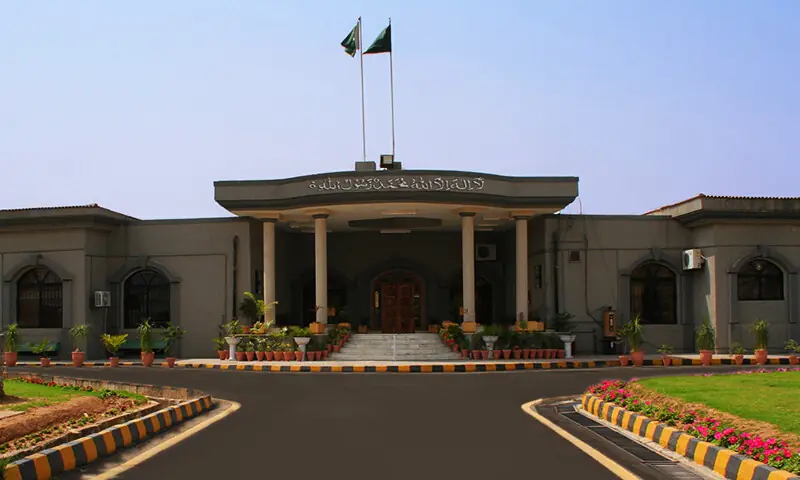
ISLAMABAD: The Islamabad High Court (IHC) has unlocked approximately Rs506 billion in disputed tax revenue over the past year by resolving hundreds of long-pending tax and revenue cases and lifting stay orders that had blocked the Federal Board of Revenue (FBR) from collecting dues, according to the court’s Annual Report 2025-26.
The report notes that prolonged litigation in tax matters has historically tied up vast public funds in courts, affecting fiscal stability and economic circulation. To tackle this, the IHC Chief Justice implemented strategic administrative and judicial reforms in line with the National Judicial (Policy Making) Committee (NJPMC) directives.
A key initiative was the creation of specialised division benches exclusively handling tax and revenue disputes, ensuring focused hearings, consistent legal interpretation, and faster resolution of high-value cases. Two benches were initially formed: one comprising Justice Babar Sattar and Justice Sardar Ejaz Ishaq Khan, and another including Justice Muhammad Azam Khan and Justice Inaam Ameen Minhas. Later, Justice Saman Rafat Imtiaz also joined a tax bench with Justice Sattar, further strengthening capacity.
Between April 1, 2025, and February 4, 2026, these benches disposed of 788 cases involving disputed amounts totaling Rs506.13 billion. The bench led by Justice Azam Khan and Justice Minhas decided 178 cases, covering Rs456.18 billion — the largest share. The benches headed by Justice Sattar, Justice Ishaq Khan, and Justice Imtiaz handled 610 cases, involving over Rs49.9 billion.
The removal of stay orders enabled the FBR to enforce tax recovery, releasing substantial funds that had been blocked for years. The court described this as a “targeted, result-oriented case management strategy”, highlighting how judicial specialisation can deliver tangible economic and institutional benefits quickly.
The report also mentions broader judicial reforms, including the disposal of over 3,000 bail applications during the year, aided by a dedicated police cell within court premises to ensure faster service of notices and timely production of records.
LHC sets aside Fauji Wind Energy sales tax case
In a related development, the Lahore High Court (LHC) Rawalpindi Bench annulled a Punjab Revenue Authority (PRA) appellate tribunal decision in a sales tax dispute involving Fauji Wind Energy, ruling the proceedings illegal and beyond the authority of the PRA.
A division bench of Justice Jawad Hassan and Justice Mirza Viqas Rauf quashed the show-cause notice, order-in-original, and the appellate tribunal’s February 25, 2025 order. Justice Hassan’s judgment cited precedents including Fauji Cement Company Limited vs Government of Punjab and Rahat Cafe, Rawalpindi vs Government of Punjab, emphasizing that the PRA had exceeded its statutory and territorial jurisdiction.
The dispute arose from a June 15, 2016 show-cause notice, alleging that Fauji Wind Energy failed to withhold Punjab Sales Tax on services received between July 1, 2014, and June 30, 2015, with payments exceeding Rs3.05 billion and a claimed tax liability of Rs488 million. The court ruled that the services were consumed in Sindh, where the company’s operations are based, not Punjab, invalidating the PRA’s claim.