
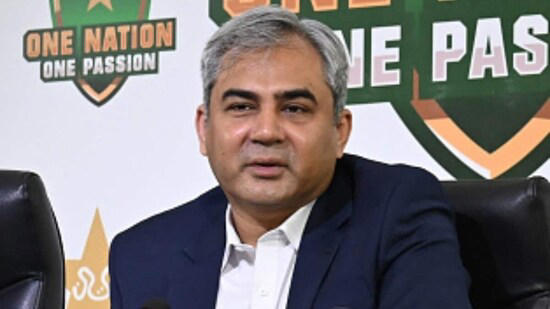
vPakistan Cricket Board (PCB) Chairman Mohsin Naqvi on Tuesday said his recent meetings with officials from the Bangladesh Cricket Board (BCB) and the International Cricket Council (ICC) were solely aimed at ensuring “respect for Bangladesh”.
Speaking to reporters in Peshawar, a day after the government withdrew its decision to boycott Pakistan’s T20 World Cup group-stage match against India on February 15, Naqvi said the discussions focused entirely on highlighting what he described as the injustice done to Bangladesh.
The government had earlier announced on February 1 that Pakistan would boycott the match against India after Bangladesh were replaced by Scotland in the tournament. Bangladesh had declined to tour India, citing security concerns amid strained political ties between the two countries.
The decision triggered extensive negotiations involving the ICC, the cricket boards of Pakistan and Bangladesh, consultations at the government level, and diplomatic efforts by friendly nations including Sri Lanka and the United Arab Emirates.
Addressing reports about conditions discussed in his Sunday meeting with ICC and BCB officials, Naqvi clarified: “We did not discuss anything apart from Bangladesh; our only purpose was to get Bangladesh respect and to highlight the injustice done to them.
“You saw that whatever demands Bangladesh made were accepted. That was the objective.”
He stressed that there was no personal or institutional interest behind the talks. “Our task was purely related to Bangladesh. The government made its decision on that basis. Once their demands were accepted and it was acknowledged that injustice had occurred, we agreed to play,” he added.
The T20 World Cup, co-hosted by India and Sri Lanka, began on February 7 but was marred by political tensions after Bangladesh refused to participate in India and the ICC declined its request to shift matches to Sri Lanka.
Pakistan initially confirmed participation in the tournament but said it would not play its scheduled match against India in Colombo. In response, the ICC stated that “selective participation” was inconsistent with the principles of a global sporting event, where all qualified teams are expected to compete according to the agreed schedule. It also urged the PCB to consider the long-term consequences for cricket in Pakistan.
Reports later indicated that the ICC launched back-channel efforts to defuse the crisis and prevent potential financial losses. Sri Lanka’s cricket authorities also appealed to Pakistan to reconsider its stance.
Pakistan captain Salman Agha said the team would again consult the government if it were to face India in the semi-finals or final.
Over the weekend, BCB chief and ICC Deputy Chair Imran Khawaja travelled to Lahore for lengthy talks with Naqvi. Sri Lankan President Anura Kumara Dissanayake also urged Pakistan to play the fixture during a phone call with Prime Minister Shehbaz Sharif, while BCB President Aminul Islam publicly encouraged Pakistan to go ahead with the match.
Following these developments, the government reversed its earlier decision to boycott. The ICC subsequently confirmed that no financial, sporting or administrative penalties would be imposed on the BCB. It also announced that Bangladesh would host an ICC event ahead of the ICC Men’s Cricket World Cup 2031 as part of a compensatory arrangement.
Pakistan Cricket Board (PCB) Chairman Mohsin Naqvi on Tuesday said his recent meetings with officials from the Bangladesh Cricket Board (BCB) and the International Cricket Council (ICC) were solely aimed at ensuring “respect for Bangladesh”.
Speaking to reporters in Peshawar, a day after the government withdrew its decision to boycott Pakistan’s T20 World Cup group-stage match against India on February 15, Naqvi said the discussions focused entirely on highlighting what he described as the injustice done to Bangladesh.
The government had earlier announced on February 1 that Pakistan would boycott the match against India after Bangladesh were replaced by Scotland in the tournament. Bangladesh had declined to tour India, citing security concerns amid strained political ties between the two countries.
The decision triggered extensive negotiations involving the ICC, the cricket boards of Pakistan and Bangladesh, consultations at the government level, and diplomatic efforts by friendly nations including Sri Lanka and the United Arab Emirates.
Addressing reports about conditions discussed in his Sunday meeting with ICC and BCB officials, Naqvi clarified: “We did not discuss anything apart from Bangladesh; our only purpose was to get Bangladesh respect and to highlight the injustice done to them.
“You saw that whatever demands Bangladesh made were accepted. That was the objective.”
He stressed that there was no personal or institutional interest behind the talks. “Our task was purely related to Bangladesh. The government made its decision on that basis. Once their demands were accepted and it was acknowledged that injustice had occurred, we agreed to play,” he added.
The T20 World Cup, co-hosted by India and Sri Lanka, began on February 7 but was marred by political tensions after Bangladesh refused to participate in India and the ICC declined its request to shift matches to Sri Lanka.
Pakistan initially confirmed participation in the tournament but said it would not play its scheduled match against India in Colombo. In response, the ICC stated that “selective participation” was inconsistent with the principles of a global sporting event, where all qualified teams are expected to compete according to the agreed schedule. It also urged the PCB to consider the long-term consequences for cricket in Pakistan.
Reports later indicated that the ICC launched back-channel efforts to defuse the crisis and prevent potential financial losses. Sri Lanka’s cricket authorities also appealed to Pakistan to reconsider its stance.
Pakistan captain Salman Agha said the team would again consult the government if it were to face India in the semi-finals or final.
Over the weekend, BCB chief and ICC Deputy Chair Imran Khawaja travelled to Lahore for lengthy talks with Naqvi. Sri Lankan President Anura Kumara Dissanayake also urged Pakistan to play the fixture during a phone call with Prime Minister Shehbaz Sharif, while BCB President Aminul Islam publicly encouraged Pakistan to go ahead with the match.
Following these developments, the government reversed its earlier decision to boycott. The ICC subsequently confirmed that no financial, sporting or administrative penalties would be imposed on the BCB. It also announced that Bangladesh would host an ICC event ahead of the ICC Men’s Cricket World Cup 2031 as part of a compensatory arrangement.