
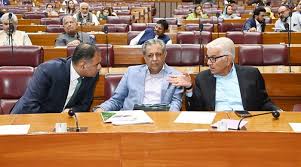
ISLAMABAD: The National Assembly on Tuesday adopted a resolution calling for a “strong and coordinated” national response against both external sponsors and internal facilitators of terrorism.
The resolution was tabled by Parliamentary Affairs Minister Dr. Tariq Fazal Chaudhry amid ongoing discussions on the security situation in Balochistan following a series of deadly attacks across the province on Saturday. It was passed with a majority vote.
The resolution condemned the recent terrorist incidents in Balochistan, highlighting that innocent civilians were targeted and women were exploited as weapons—an act described as “completely contrary to Islamic, Pakistani, and Baloch values.” It called for an “immediate, aggressive, coordinated, and effective national response” across political, diplomatic, military, intelligence, legal, and public fronts to dismantle networks of funding, smuggling, and propaganda.
It also cited evidence pointing to external sponsorship of terrorism, raising serious concerns over India’s role, while noting that terrorist networks in neighboring countries provide logistical, operational, financial, and training support.
The resolution expressed solidarity with the victims, emphasizing that attacks on civilians, women, and children are “unforgivable” and underlined zero tolerance against such elements. It also lauded the timely response by security forces, law enforcement agencies, the Balochistan government, and the civil administration.
According to the military’s media wing, militants from Fitna-al-Hindustan carried out coordinated attacks across Balochistan on Saturday. Security operations killed 92 terrorists initially, with the total rising to 177 over 48 hours.
Lawmakers Raise Alarm
Lawmakers across parties, including PTI, PPP, and JUI-F, voiced concerns over the rise in terrorism. Opposition Leader Mehmood Khan Achakzai called for recognition of provincial rights over local resources.
PTI’s Asad Qaiser stressed addressing the root causes of insurgency in Balochistan and Khyber Pakhtunkhwa, linking unrest to denied basic rights and unequal treatment by the state. He also highlighted cross-border terrorism issues with Afghanistan and urged resolution through diplomacy, alongside full implementation of the National Action Plan.
JUI-F’s Aliya Kamran criticized the delayed response of security forces, questioned why women were being used as suicide bombers, and called for dialogue with Balochistan’s population. Fellow JUI-F lawmaker Usman Badini noted systemic neglect in the province, citing electricity shortages and lack of rights as factors fueling unrest.
PTI’s Noor Alam Khan and PPP’s Sehar Kamran stressed that terrorism is spreading beyond Balochistan, affecting Khyber Pakhtunkhwa, with coordinated attacks indicating external involvement, particularly from India and the TTP. Both called for national unity to combat terrorism.
Defence Minister’s Briefing
Defence Minister Khawaja Asif had briefed the assembly on Monday, rejecting any justification of violence under political or nationalist claims. He described recent attacks as organised criminal activity falsely portrayed as a freedom struggle.
Balochistan Attacks
The January 31 attacks targeted Quetta and other districts, including Mastung, Nushki, Dalbandin, Kharan, Panjgur, Tump, Gwadar, and Pasni. Security forces killed 92 terrorists initially, including three suicide bombers, while 15 personnel and at least 18 civilians—including women, children, and elderly—were killed. Intelligence reports confirmed the attacks were orchestrated by leaders operating from outside Pakistan.