
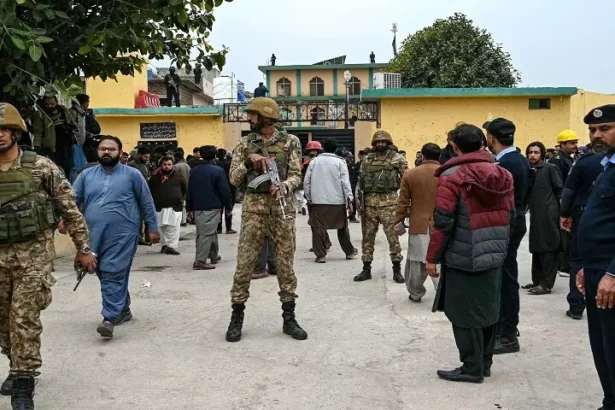
ISLAMABAD: Friday’s suicide bombing at the Tarlai Imambargah marks the second major terrorist attack in the federal capital in less than three months, raising serious questions about security arrangements despite stepped-up measures by police and the city administration.
The previous attack occurred on November 11 last year, when a lone suicide bomber detonated himself outside the main entrance of the Judicial Complex in G-11 after failing to gain entry. The blast killed at least 12 people and injured 36 others.
In the aftermath of that incident, authorities established multiple police pickets across the city. The Islamabad Traffic Police also began restricting several busy roads during peak hours by erecting daily barricades to check suspicious activity — a move that caused widespread inconvenience for commuters.
Following Friday’s attack, anguished relatives gathered at the Pakistan Institute of Medical Sciences (Pims) to search for missing loved ones, with many voicing anger over what they described as the failure of police and law enforcement agencies to prevent yet another deadly strike.
A senior police officer, however, defended the security posture, noting that the Tarlai Imambargah is located in a rural area on the outskirts of Islamabad, while enhanced security measures were largely focused on urban sectors. He said policing efforts were primarily concentrated on government buildings and other sensitive installations.
The officer added that law enforcement agencies continuously monitor suspicious movements within the city through Safe City cameras and maintain records of visitors staying at hotels and guest houses. In contrast, he said, surveillance in rural areas relies largely on “human intelligence,” which he described as more difficult to deploy effectively, noting that such areas often serve as “safe havens” for militants.
It is worth recalling that in the wake of the November 11 attack, Interior Minister Mohsin Naqvi had announced plans to make e-tags mandatory for vehicles entering Islamabad within two weeks. Days later, Minister of State for Interior Senator Talal Chaudhry, speaking at a press conference alongside Inspector General of Police Syed Ali Nasir Rizvi, said e-tags would be compulsory for all vehicles operating in the capital.
Subsequently, authorities installed e-tag readers and cameras at 11 to 14 entry and exit points across Islamabad under the supervision of the Safe City Authority. These systems were linked to the Safe City network and mounted on newly erected poles to scan vehicle e-tags and registration plates.
Officials estimate that between 400,000 and 500,000 vehicles use Islamabad’s roads daily, with a significant number entering from neighbouring areas, particularly Rawalpindi. According to the capital administration, e-tags had been installed on 203,915 vehicles as of February 5, while around 19 designated points remain operational for vehicle tagging.