
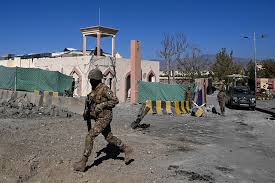
Inter-Services Public Relations (ISPR) Director General Lt Gen Ahmed Sharif Chaudhry said on Tuesday that Afghan nationals were involved in all major “high-impact” terrorist incidents in Pakistan during 2025, as he presented a detailed overview of the country’s counter-terrorism operations over the past year.
Addressing a press conference, the military spokesperson said the sole purpose of the briefing was to outline counter-terrorism measures, stressing that terrorism remained “the biggest threat faced by the state of Pakistan.”
2025 a ‘landmark year’ in counter-terrorism
Lt Gen Chaudhry described 2025 as a “landmark and consequential year” in Pakistan’s fight against terrorism, citing four main reasons: unprecedented operational intensity, nationwide clarity on the nature of terrorism, international recognition of Pakistan’s position, and renewed implementation of the National Action Plan (NAP).
He said the state and public had reached a shared understanding that terrorist groups had no religious or national legitimacy, referring to the banned Tehreek-i-Taliban Pakistan (TTP) as Fitna-al-Khawarij and Balochistan-based militant outfits as Fitna-al-Hindustan, terms the state uses to underline their alleged external backing.
The DG ISPR said the global community had increasingly acknowledged that Afghanistan had become a base for terrorist activity, while Pakistan had reinvigorated the NAP framework, including the military’s counter-terrorism campaign Azm-i-Istehkam, launched in 2024.
He conceded, however, that gaps remained in NAP implementation and further improvement was needed.
Over 75,000 intelligence-based operations
Presenting statistics, the DG ISPR said Pakistani law enforcement agencies carried out 75,175 intelligence-based operations (IBOs) in 2025 — an average of 206 per day. Of these, 58,778 operations took place in Balochistan, 14,658 in Khyber Pakhtunkhwa, and 1,739 elsewhere.
A total of 5,397 terrorist incidents were reported nationwide, with 71 per cent occurring in KP and 29 per cent in Balochistan. He said 2,597 terrorists were killed during the year, while 1,235 civilians and security personnel were martyred.
Pakistan also recorded 27 suicide attacks, including two involving female bombers.
Explaining the high number of incidents in KP, the DG ISPR cited what he termed a “political-terror nexus” and a permissive environment that enabled militant activity.
Afghanistan’s role after 2021
Lt Gen Chaudhry traced the resurgence of terrorism to developments in Afghanistan following the 2021 Doha Agreement, saying the Afghan Taliban failed to honour commitments to form an inclusive government, prevent terrorism, or uphold women’s rights.
Instead, he said Afghanistan had turned into a hub for multiple terrorist groups, including foreign fighters, adding that around 2,500 non-Pakistani and non-Afghan militants had recently relocated there from Syria.
He alleged that the Afghan Taliban reorganised, trained, and supported the TTP, while promoting a narrative that misrepresented the US withdrawal as a militant victory to boost recruitment.
The DG ISPR also pointed to a war economy, saying militant networks were sustained through external sponsors after the flow of international aid to Afghanistan dried up. He alleged that India was the primary financial patron of terrorism in Pakistan, using Afghan territory as a base.
He added that $7.2 billion worth of advanced US military equipment left behind in Afghanistan was now accessible to militant groups through black markets.
‘All major attacks involved Afghans’
Listing 10 major terrorist incidents from 2025, Lt Gen Chaudhry said all 78 militants involved were Afghan nationals and were killed in operations. Sixty civilians were martyred in those attacks.
“This is not the military’s fight alone,” he said. “It is the fight of the people of Pakistan. If we do not confront them, they will take their violence into our homes, schools and markets.”
He said 16 high-value militant leaders were among those killed, including senior TTP figures.
Border operations and October strikes
Referring to a spike in terrorism after a four-day conflict with India in May 2025, the DG ISPR said militants were activated following India’s defeat, with Afghanistan serving as their operational base.
He said Pakistan repeatedly urged Kabul to curb cross-border militancy before conducting targeted strikes against TTP elements in October 2025, stressing that Afghan Taliban posts were not initially targeted.
When Afghan forces retaliated by attacking Pakistani posts, he said Pakistan responded forcefully, destroying multiple positions along and inside Afghan territory.
Following the border closure, he said terrorist activity declined, with the number of militants killed rising to 276 per month in the final quarter of the year.
Counter-terrorism pillars and technology
The DG ISPR outlined three pillars of Pakistan’s counter-terrorism strategy: border engagements, small-team offensive actions, and intelligence-driven technical surveillance.
Rejecting claims that the military was using armed drones in populated areas, he said militants had conducted 405 quadcopter attacks in KP alone, while security forces used drones strictly for surveillance and avoided collateral damage.
He said counter-terrorism also involved public engagement and narrative-building, stressing that the state and public stood united.
Repatriation and internal challenges
On Afghan repatriation, the DG ISPR said all refugee camps had been cleared in Punjab and Balochistan, but progress in KP was slow, with only five of 43 camps shut.
He also highlighted low conviction rates, narcotics trafficking, illegal weapons, and delays in terrorism cases as persistent challenges.
‘No space for any terrorist’
Concluding the briefing, Lt Gen Chaudhry said Pakistan would continue its fight against terrorism “with singularity of purpose and narrative.”
“There is only one kind of terrorist,” he said. “A dead terrorist.”
He added that Pakistan would calibrate its policy toward Afghanistan based on circumstances, prioritising national security and territorial integrity.