
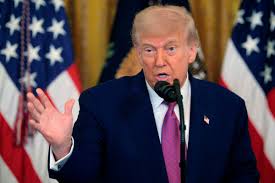
Iranian President Masoud Pezeshkian has ordered the opening of nuclear talks with the United States, Iranian media reported on Monday, as US President Donald Trump warned that “bad things” would happen if a deal with Tehran was not reached.
Trump’s comments came amid heightened tensions following Iran’s crackdown on anti-government protests that peaked last month. In response, the US president has threatened military action and ordered the deployment of an aircraft carrier strike group to the Middle East.
Despite the warnings, Trump said he remained hopeful that Washington could “work something out” with Tehran, while cautioning that time was running out.
Iran, for its part, has said it prefers diplomacy but has vowed a forceful response to any aggression.
According to Iran’s Fars news agency, President Pezeshkian has instructed officials to begin negotiations with Washington over Iran’s nuclear programme. The report, citing an unnamed government source, was also published by the state-run newspaper Iran and the reformist daily Shargh.
A meeting could take place in Turkiye on Friday, following mediation efforts by Egypt, Qatar, Turkiye and Oman, an Arab official told AFP on condition of anonymity. US outlet Axios reported that Iranian Foreign Minister Abbas Araghchi was expected to meet US envoy Steve Witkoff in Istanbul to discuss a possible nuclear agreement.
Western governments believe Iran’s nuclear programme is aimed at developing an atomic bomb, an accusation Tehran has repeatedly denied.
In an interview with CNN on Sunday, Araghchi said Iran and the US shared a common position on nuclear weapons. “President Trump said no nuclear weapons, and we fully agree,” he said, adding that sanctions relief would be expected in return for any agreement.
Iranian foreign ministry spokesman Esmaeil Baqaei said Tehran was finalising a framework for negotiations, with messages between the two sides being exchanged through regional intermediaries.
Regional diplomacy and warnings
Turkiye has led regional diplomatic efforts to ease tensions, with Araghchi holding talks in Istanbul last week and engaging counterparts in Egypt, Saudi Arabia and Jordan.
Jordanian Foreign Minister Ayman Safadi said on Monday that his country would not allow its territory to be used in any conflict against Iran.
Iranian leaders, including Supreme Leader Ayatollah Ali Khamenei, have warned that any US attack would trigger a wider regional war.
In Tehran, pensioner Ali Hamidi, 68, told AFP he was not afraid of war but criticised both Washington and Iran’s leadership. “America should mind its own business,” he said, adding that Iranian officials had failed to address crippling economic problems facing ordinary citizens.
Protests, crackdown and international fallout
The unrest began in late December over economic hardship and escalated sharply in early January. Iranian authorities have described the protests as “riots” fuelled by foreign enemies, with Khamenei likening them to a coup attempt.
Tehran has acknowledged thousands of deaths during the protests. On Sunday, the presidency published the names of 2,986 people killed, out of a total of 3,117 deaths reported by authorities. Officials say most were security personnel or bystanders, blaming the violence on “terrorist acts”.
Rights groups estimate at least 40,000 people have been arrested.
A 25-year-old Iranian woman, Selina, who declined to give her full name, told AFP she fled to Iraqi Kurdistan to escape what she described as constant fear. “It’s not safe for us,” she said. “Soldiers are everywhere.”
The crackdown prompted the European Union to designate Iran’s Islamic Revolutionary Guard Corps as a terrorist organisation. Iranian lawmakers retaliated by applying the same label to European armies.
The EU and Britain have imposed fresh sanctions on Iranian officials, including the interior minister. Iran’s foreign ministry said it had summoned EU ambassadors in protest and warned further responses were forthcoming.
Iranian state television also reported the arrest of four foreign nationals in Tehran for alleged involvement in the unrest, without disclosing their nationalities.