
Prime Minister Shehbaz Sharif on Wednesday pledged to raise Pakistan–Kazakhstan bilateral trade to $1 billion within the next year, citing the untapped economic potential of the two countries.
The commitment was announced during a joint press conference with Kazakhstan President Kassym-Jomart Tokayev, who is on a two-day official visit to Pakistan — the first by a Kazakh head of state in 23 years.
Following their talks, the two sides signed 27 agreements and memorandums of understanding (MoUs) spanning key sectors including petroleum, mining, maritime affairs, energy, agriculture and trade facilitation.
Welcoming the visiting delegation, PM Shehbaz said the meetings had been “very useful and productive” and stressed the importance of swiftly translating MoUs into concrete agreements and implementation.
“If these MoUs are realised, our economic, trade and cultural relations will rise several notches higher,” the premier said, assuring full support for their speedy execution.
Despite strong diplomatic ties, PM Shehbaz noted that bilateral trade stood at just $250 million last year, calling it far below the true potential of the relationship.
“Let us commit to increasing this volume to $1bn in the coming year,” he said, urging business communities from both sides to pursue joint ventures, particularly in energy, mining and infrastructure.
The premier also announced agreement on a Belarus–Russia–Kazakhstan–Uzbekistan–Afghanistan–Pakistan transport corridor, aimed at enhancing regional connectivity. He assured Kazakhstan of full access to Pakistan’s transit infrastructure and seaports, including Karachi and Gwadar.
On energy cooperation, PM Shehbaz said collaboration would be a “win-win” arrangement, adding that Pakistan viewed Kazakhstan as a strategic and highly valued partner in Central Asia.
He praised President Tokayev’s leadership and congratulated him on receiving the Nishan-i-Pakistan, describing it as recognition of his contribution to strengthening bilateral ties.
Pakistan a ‘reliable and important partner’
In his remarks, President Tokayev described Pakistan as a “reliable and important partner in South Asia and beyond”, highlighting centuries-old links rooted in the legacy of the Silk Road.
“Our nations share common values, traditions and aspirations for the future,” he said.
He confirmed that both sides had signed a joint declaration establishing a strategic partnership, elevating relations to a new level.
President Tokayev lauded Pakistan’s growing regional and global standing, its role in promoting peace and stability, and its election as a non-permanent member of the UN Security Council.
He noted that bilateral trade had doubled over the past year, adding that both leaders agreed to pursue concrete measures to reach the $1bn trade target “in the near future”.
The Kazakh president said transport and logistics projects would be prioritised, with Pakistan’s ports offering Kazakhstan alternative access to international markets. He also confirmed discussions on the Trans-Caspian Transport Corridor, transit routes via Afghanistan, and the possible resumption of direct flights between the two countries.
On energy, Tokayev said talks covered the TAPI gas pipeline, while agreements in agriculture would help expand trade and establish joint production facilities.
He invited Pakistani companies to set up manufacturing units in Kazakhstan and expressed readiness to offer favourable conditions for investors. Cooperation in defence, security, artificial intelligence and digital technologies was also discussed.
More than 250 companies from both countries are expected to sign commercial agreements at the Pakistan–Kazakhstan Business Forum, he added.
Expanded cooperation
Earlier, Deputy Prime Minister and Foreign Minister Ishaq Dar met President Tokayev and reaffirmed Pakistan’s commitment to expanding cooperation across political, economic and people-to-people domains.
Separately, Commerce Minister Jam Kamal Khan held talks with Kazakhstan’s Minister of Trade and Integration Arman Shaqqaliev, with both sides agreeing that improved rail, road and multimodal connectivity was essential to boosting trade.
The ministers identified priority sectors including agriculture, pharmaceuticals, textiles, sports goods, leather, mining, energy and infrastructure, and agreed to develop a structured roadmap for business-to-business engagement.
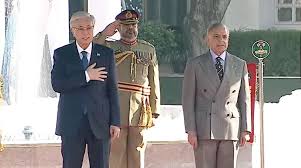
President Tokayev was earlier accorded a guard of honour upon arrival in Islamabad. He is accompanied by a high-level delegation of senior officials and cabinet members.
Officials say the visit offers a timely opportunity to deepen cooperation in trade, connectivity and investment, helping Pakistan position itself as a land bridge between Central and South Asia, while enabling Kazakhstan to diversify trade routes amid regional uncertainty.