
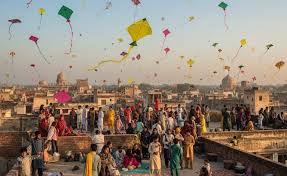
After years of silence, Basant returns, and Lahore’s kites wait — patient, hopeful, ready to lift the city’s spirit once more.
By Salman Tahir | February 4, 2026
In Lahore, where the Ravi whispers secrets to the minarets of the Badshahi Mosque, spring does not tiptoe in. It bursts forth, jubilant and untamed, painting the skies with colour, music, and motion.
When winter’s fog finally yields to the sun, the city’s rooftops awaken. Paper kites (‘patangs’) tremble with anticipation, their tails slicing the blue like calligraphy in motion.
This is Basant: centuries-old, steeped in marigold blooms, kite strings, and the uncontainable joy of flight.
Bo Kata! — A Festival of Freedom and Flight
Basant traces its roots to Vasant Panchami, the ancient celebration of spring when mustard fields unfurl like golden carpets and Goddess Saraswati, clad in saffron, is invoked with music and learning.
But in Lahore, Basant long outgrew its ritual origins. It became unapologetically Punjabi, exuberantly urban, and inclusive: Hindu, Muslim, and Sikh households alike climbing rooftops in amber and marigold, turning the city into a living mosaic of celebration.
Historical chronicles speak of Basant at its zenith during the Mughal era — kites wheeling above Lahore Fort, strings guided by hennaed hands, the air thick with poetry and devotion. Even Sufi poet Amir Khusrau captured it in verse: a season of love, colour, and divine intoxication.
Under Maharaja Ranjit Singh, Basant reached theatrical heights. Streets draped in marigold, soldiers in turmeric turbans, women swaying on jhulas, dhols beating through every lane, and above it all, kite battles — cheers of “Bo kata!” ringing from rooftop to rooftop.
Yet the true poetry of Basant lies not in grandeur but in the humble kite itself. Fragile paper, bamboo frame, tethered by a single string — yet in every hand, it becomes a symbol of transcendence.
For a Lahori child or elder, a kite is more than play; it is a quiet rebellion against gravity. As the wind carries it upward, the kite escapes the dust of crowded streets, the divisions of class and circumstance, bearing dreams and whispers skyward.
The Ghost of Basant
For nearly two decades, the skies remained silent. The ban descended after tragic accidents: glass-coated or metallic kite strings claiming lives, cutting through the air, through rooftops, through hope itself.
Families once armed with spools of thread now looked up at empty skies, feeling absence like a missing heartbeat. Children who never knew the festival carried nostalgia for a joy they had only seen in old photographs. Basant became a ghost lingering in memory — whispered in stories, kept alive in quiet tribute, in turmeric-hued kurtas, in the patient work of kite-makers in hidden corners.
Patangs Rise Again, Responsibly
This February, the wind begins to stir once more. Under the Punjab Regulation of Kite Flying Ordinance, 2025, only cotton strings, QR-coded registration, drone monitoring, and strict limits on threads will allow the festival to soar safely.
From February 6 to 8, 2026, rooftops across Lahore will once again host the playful battles of patangs. The dhol will beat, marigold sweets will scent the air, and rooftops will fill with laughter — a city reclaiming joy, carefully, wisely, after years of silence.
Anwar Bajwa, a lifelong resident of Anarkali, captures it best:
“Basant was never just a day; it was part of who I was. As a boy, I ran to the rooftop at dawn, thread in hand, heart racing for the wind to lift our kites. Every tug felt like my heartbeat reaching higher. When the rooftops went silent, it was like losing a piece of my childhood. Now, hearing the kites will fly again, I feel that old excitement stirring inside me, like time has turned back, and I’m that boy once more.”
The Return of Flight and Spirits
The skies of old Basant were tapestries of scarlet, emerald, indigo, and amber, woven by thousands of kites locked in gentle combat. Streets brimming with laughter, strangers becoming friends, families united in unbridled joy.
The kite carries quiet symbolism: stars, eyes, flowers — each a small work of art, born in the hands of artisans who know the wind’s secrets. Below, mustard-gold fields sway, mirroring the colour above.
After years of waiting, the skies will fill again. This time, every flight is sacred. Basant returns not as a fleeting spectacle, but as proof that even after silence, the human spirit — fragile as paper, defiant as wind — can rise, tethered only by a thin thread of care, soaring toward a boundless sky that belongs once more to all of Lahore.