
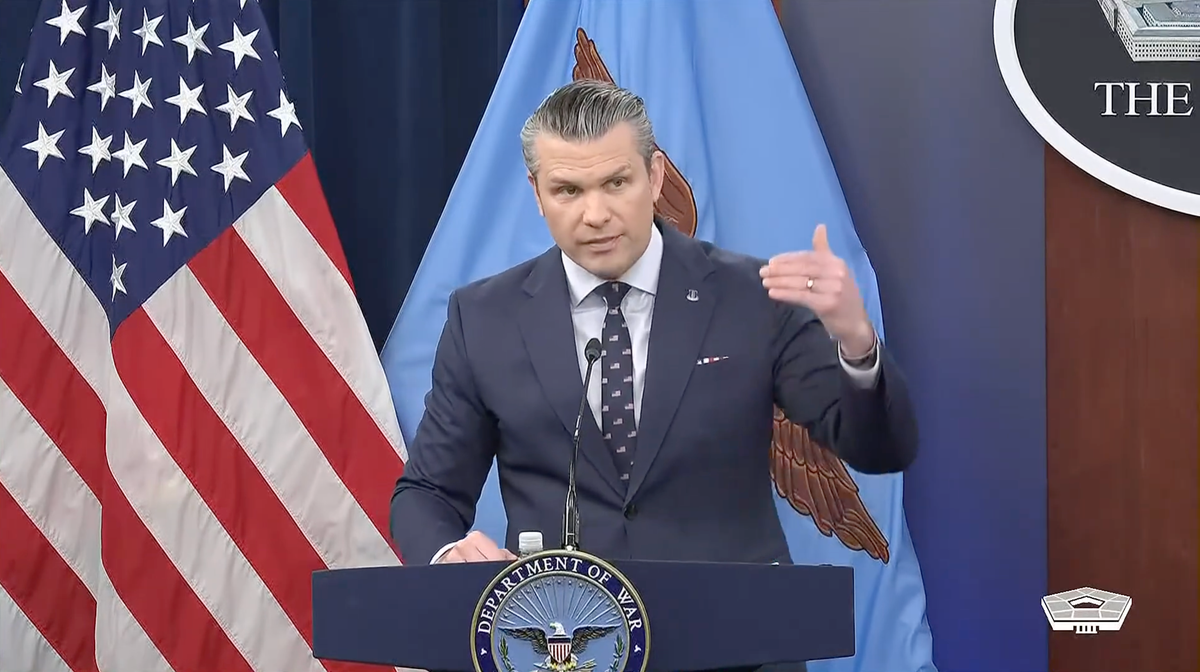
WASHINGTON: In a dramatic shake-up at the Pentagon, US Defence Secretary Pete Hegseth has forced Army Chief of Staff General Randy George into immediate retirement amid the ongoing conflict with Iran, multiple US media outlets reported on Friday.
The move is being described as one of the most significant military leadership overhauls in decades.
Alongside General George’s removal, General David Hodne, head of the Army’s Transformation and Training Command, and Major General William Green, chief of the Army Chaplain Corps, were also dismissed. The developments were first reported by The Washington Post and later confirmed by CBS News and several other media organisations.
General George’s departure comes roughly 18 months into what is traditionally a four-year term and arrives as US military operations against Iran enter their fifth week.
According to CBS News, defence officials said Hegseth was seeking leadership that more closely reflects both his vision and that of President Donald Trump for the future direction of the Army.
The decision marks a sharp break from long-standing Pentagon norms and highlights growing internal tensions. A seasoned infantry officer and graduate of West Point, George was nominated by then-President Joe Biden in 2023 and later confirmed by the Senate.
His early exit is part of a wider pattern under Hegseth, who has already removed or sidelined more than a dozen senior military officials across multiple branches, including top officers in the Air Force and Navy. Critics warn that such sweeping changes could destabilise military leadership at a critical moment in wartime.
Reports by CNN and Reuters suggested that internal disagreements had been mounting, particularly as George worked closely with Army Secretary Daniel P. Driscoll and reportedly pushed back against some of Hegseth’s personnel decisions.
The New York Times reported that tensions intensified over a promotion list after George and Driscoll allegedly refused to remove four minority and female officers at Hegseth’s request, arguing that the officers were fully qualified and had strong service records.
In the interim, acting Army leadership will be assumed by General Christopher LaNeve, the current vice chief of staff and a former aide to Hegseth. His appointment is widely viewed as a signal that the administration is moving toward leadership more closely aligned with its strategic priorities.
LaNeve’s swift rise — from commanding the 82nd Airborne Division to taking over as acting Army chief — has sparked debate over whether political loyalty is increasingly influencing top military appointments.
Military analysts cited by several outlets have raised concerns that sudden leadership changes during an active conflict could disrupt operational planning, coordination with allied forces, and long-term military readiness as the war with Iran intensifies.
CNN noted that the Pentagon has not issued any official statement linking the leadership reshuffle to battlefield developments, leaving uncertainty over its impact on troop movements, logistics, and inter-service coordination.
The shake-up has also drawn scrutiny from lawmakers and defence experts at home, many of whom fear that repeated turnover at the highest levels could erode trust between civilian leaders and the military while complicating the broader Iran campaign.
Supporters of Hegseth’s decision, however, argue that aligning senior military leadership with the administration’s objectives — including the potential for expanded ground operations — could bring renewed momentum to a campaign that has recently faced setbacks and increasing regional resistance.
Several US media outlets have framed General George’s removal as both a personal rebuke and a broader institutional realignment within the Pentagon, one that may shape how the Army conducts the war, works with allies, and responds to mounting political pressure from both the White House and Congress as the conflict with Iran enters a more decisive stage.