
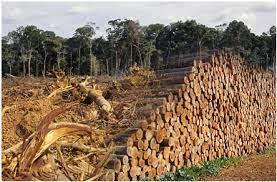
Sindh has lost nearly 80 per cent of its forest cover since Pakistan’s creation — much of it within the past three decades. The consequences of this slow ecological collapse are now impossible to ignore.
Along the Thatta–Karachi bypass, a rabrri seller stands beneath the open sun, sweat streaking through the dust on his face. There are no trees left to offer shade — only asphalt, traffic and heat. He recalls a different Makli from two decades ago, when thick roadside trees softened summers, light drizzles settled the dust, and people lingered outdoors. “Even the heat felt different then,” he says.
That balance has vanished. What remains is relentless heat — and trucks.
A Pipeline of Timber
One truck laden with freshly cut wood roars past, then another, then another — neem, babul and keekarr stacked high, trunks thick enough to suggest decades of growth. These vehicles form a visible supply chain funneling timber from lower Sindh into Karachi. Each truck carries more than wood: it carries away shade, wildlife habitat, soil stability and the ecological foundations of rural Sindh.
Illegal timber trucks have become a routine sight. According to estimates, Sindh has lost almost four-fifths of its forests since 1947, much of it in recent decades. As deforestation intensifies heatwaves and climate stress, the question grows unavoidable: are authorities failing to act — or actively enabling the destruction?
Research shows that deforestation increases local surface temperatures by up to 4.5°C. In Sindh, this engineered loss of tree cover has translated into recurring heat disasters. Hundreds of people and livestock die each year as heatwaves intensify.
According to the Provincial Disaster Management Authority, the 2024 heatwave alone resulted in over 5,300 hospital admissions and 158 livestock deaths. Between April and May 2025, 675 heatstroke cases were reported. Across 26 districts, 8.6 million people faced food insecurity driven by heat and drought.
Given this direct link, why does deforestation continue unchecked?
Drivers and residents along timber routes say each truck pays roughly Rs4,000 to Forest Department officials to pass freely. Timber from Tharparkar, Badin, Sujawal, Thatta and other districts converges onto the N-5 highway — roughly one truck every 15 minutes. That translates into nearly Rs12 million a month on just one route.
“Pay, and you go anywhere,” one driver says. “Don’t pay, and you’re in trouble.”
No permits are visible. No inspections occur. The Sindh Forest Department, despite repeated claims of afforestation and land reclamation, did not respond to queries.
A Long History of Loss
Sindh’s forests were not destroyed overnight. Their dismantling began under British rule after 1843, when riverine forests were surveyed, commodified and logged to fuel railways, canals and cantonments. Living ecosystems became inventories.
The construction of barrages — Sukkur in 1932, followed by Guddu and Kotri — disrupted natural flooding cycles critical for forest regeneration. By Partition, Sindh inherited colonial forest laws and roughly 294,000 hectares of protected and reserved forests.
On paper, those figures have not changed drastically. In reality, encroachment, illegal felling and reduced freshwater flows have devastated forest health. Experts estimate that up to 80 per cent of riverine forests have been destroyed or severely degraded.
Between the 1980s and early 2000s, forest cover in many areas shrank by more than two-thirds. Across the province, Sindh likely lost between 50 and 80 per cent of its forest cover compared to mid-20th century levels.
Policy as a Weapon
In 2005, the Sindh government introduced its Agroforestry Policy, ostensibly to increase tree cover through private participation. In practice, it opened vast tracts of forest land to leasing. Natural forests were cleared first; replantation promises were rarely enforced.
The policy was expanded in 2010 despite mounting damage, then scrapped in 2014. A later government review admitted weak law enforcement and explicitly labelled the agroforestry lease policy “detrimental”.
Yet funds continued to be allocated for reclamation while powerful encroachers delayed eviction. According to local reporting, tens of thousands of acres in districts like Matiari remain under contractor control, despite court orders.
In Shaheed Benazirabad, large tracts of Nasri Forest have been allocated for commercial development, prompting warnings of rising temperatures, biodiversity loss and ecosystem collapse.
Complicity on the Ground
Woodcutter Ayaz Samoo has worked in forests for over 20 years. Where axes once fell slowly, chainsaws now roar. “It’s faster now,” he says. “But you don’t feel the tree anymore.”
Activist Ammar Dayo calls the destruction in Ghotki “unprecedented”, alleging direct involvement by forest officials, politicians and police. Mature babul trees worth hundreds of thousands of rupees each have been felled by the thousands, he says.
Court bans on sawmills near forests exist — but mills operate inside forest boundaries. The cutters, however, are not the profiteers.
In rural Sindh, poverty drives labourers into forest-cutting. “We cut for Rs500 a day,” a worker says. “That money feeds our families.”
But as forests vanish, livelihoods collapse. Grazing lands shrink, heat exposure rises, livestock dies, migration accelerates and poverty deepens.
A Man-Made Crisis
Environmental expert Nasir Panhwar describes riverine forests as infrastructure — infrastructure being dismantled. Biodiversity has disappeared, livelihoods have collapsed and migration is underway.
Official figures show productive forests now cover barely two per cent of Sindh’s land. Nationally, Pakistan’s forest cover stands at just 4.7 per cent — among the lowest in the region.
As of 2025, Pakistan has only five trees per person, far below sustainable thresholds. In Sindh, the figure is even lower.
Trees cool cities, retain moisture and blunt heatwaves. Without them, heat intensifies relentlessly. One mature tree cools air by up to 5°C and absorbs 22kg of CO₂ annually. Offset Sindh’s heat, and each person would need hundreds of trees — now impossible.
Fixing the System
Deforestation in Sindh is not accidental. It is a governance failure.
Reversing it requires institutional reform, legal clarity and accountability — not symbolic tree drives. The Sindh Forest Department needs independent oversight, public disclosure of permits, third-party audits and real-time monitoring using satellite technology.
Forest laws must be updated to eliminate loopholes and enforce penalties consistently. Communities must be compensated for conservation through payment-for-ecosystem-services schemes. Agroforestry must supplement, not replace, natural forests.
Crucially, the Indus must be allowed to flow. Riverine forests and mangroves depend on silt and freshwater.
Above all, deforestation must carry political consequences. Environmental collapse cannot remain invisible.
Of Trucks and Torment
Despite a government ban on night-time timber transport imposed in November 2025, trucks continue to roll through the dark. On the Thatta–Karachi bypass and N-5 highway, the ban exists mostly on paper.
By morning, when the rabrri seller opens his stall again, the trucks will still be coming — carrying away what little forest remains.